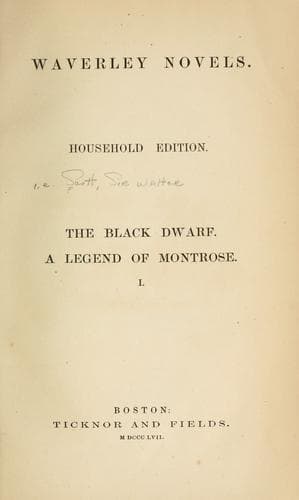
Historical fiction; Montrose, James Graham, Marquis of, 1612-1650 -- Fiction; Scotland -- History -- Charles I, 1625-1649 -- Fiction
“And if you think you owe me anything,” said the outlaw, “it is in your
power to requite me by granting me a boon.”
“Friend Ranald,” answered Dalgetty, “I have read of these boons in silly
story-books, whereby simple knights were drawn into engagements to their
great prejudice; wherefore, Ranald, the more prudent knights of this
day never promise anything until they know that they may keep their
word anent the premises, without any displeasure or incommodement to
themselves. It may be, you would have me engage the female chirurgeon
to visit your wound; though you ought to consider, Ranald, that the
uncleanness of the place where you are deposited may somewhat soil the
gaiety of her garments, concerning the preservation of which, you may
have observed, women are apt to be inordinately solicitous. I lost the
favour of the lady of the Grand Pensionary of Amsterdam, by touching
with the sole of my boot the train of her black velvet gown, which
I mistook for a foot-cloth, it being half the room distant from her
person.”
“It is not to bring Annot Lyle hither,” answered MacEagh, “but to
transport me into the room where she is in attendance upon the Knight of
Ardenvohr. Somewhat I have to say of the last consequence to them both.”
“It is something out of the order of due precedence,” said Dalgetty, “to
carry a wounded outlaw into the presence of a knight; knighthood having
been of yore, and being, in some respects, still, the highest military
grade, independent always of commissioned officers, who rank according
to their patents; nevertheless, as your boon, as you call it, is so
slight, I shall not deny compliance with the same.” So saying, he
ordered three files of men to transport MacEagh on their shoulders
to Sir Duncan Campbell’s apartment, and he himself hastened before
to announce the cause of his being brought thither. But such was the
activity of the soldiers employed, that they followed him close at the
heels, and, entering with their ghastly burden, laid MacEagh on the
floor of the apartment. His features, naturally wild, were now distorted
by pain; his hands and scanty garments stained with his own blood, and
those of others, which no kind hand had wiped away, although the wound
in his side had been secured by a bandage.
“Are you,” he said, raising his head painfully towards the couch where
lay stretched his late antagonist, “he whom men call the Knight of
Ardenvohr?”
“The same,” answered Sir Duncan,--“what would you with one whose hours
are now numbered?”
“My hours are reduced to minutes,” said the outlaw; “the more grace, if
I bestow them in the service of one, whose hand has ever been against
me, as mine has been raised higher against him.”
“Thine higher against me!--Crushed worm!” said the Knight, looking down
on his miserable adversary.
Public-domain text, read in full here on John Shaqi.
Reviews
Reviews
No reviews yet
Be the first to share your thoughts on this work.
Elsewhere in the archive
Join the Discussion
Join the discussion
Sign in to leave a comment or review.
Sign InorCreate an account