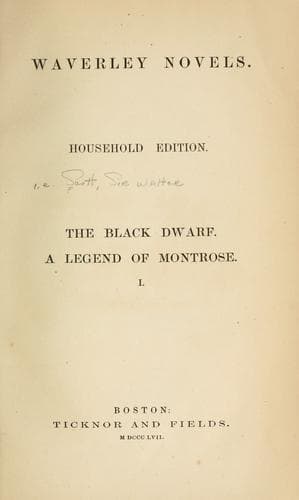
Historical fiction; Montrose, James Graham, Marquis of, 1612-1650 -- Fiction; Scotland -- History -- Charles I, 1625-1649 -- Fiction
Montrose in vain endeavoured to place the subject in a different view;
this was the point in which Angus was determined to regard it, and he
was a man of that calibre of understanding, who is incapable of being
convinced when he has once adopted a prejudice. Montrose now assumed
a higher tone, and called upon Angus to take care how he nourished
any sentiments which might be prejudicial to his Majesty’s service. He
pointed out to him, that he was peculiarly desirous that Allan’s efforts
should not be interrupted in the course of his present mission; “a
mission,” he said, “highly honourable for himself, and likely to prove
most advantageous to the King’s cause. He expected his brother would
hold no communication with him upon other subjects, nor stir up any
cause of dissension, which might divert his mind from a matter of such
importance.”
Angus answered somewhat sulkily, that “he was no makebate, or stirrer-up
of quarrels; he would rather be a peacemaker. His brother knew as well
as most men how to resent his own quarrels--as for Allan’s mode of
receiving information, it was generally believed he had other sources
than those of ordinary couriers. He should not be surprised if they saw
him sooner than they expected.”
A promise that he would not interfere, was the farthest to which
Montrose could bring this man, thoroughly good-tempered as he was on all
occasions, save when his pride, interest, or prejudices, were interfered
with. And at this point the Marquis was fain to leave the matter for the
present.
A more willing guest at the bridal ceremony, certainly a more willing
attendant at the marriage feast, was to be expected in Sir Dugald
Dalgetty, whom Montrose resolved to invite, as having been a confidant
to the circumstances which preceded it. But even Sir Dugald hesitated,
looked on the elbows of his doublet, and the knees of his leather
breeches, and mumbled out a sort of reluctant acquiescence in the
invitation, providing he should find it possible, after consulting with
the noble bridegroom. Montrose was somewhat surprised, but scorning to
testify displeasure, he left Sir Dugald to pursue his own course.
This carried him instantly to the chamber of the bride-groom, who,
amidst the scanty wardrobe which his camp-equipage afforded, was
seeking for such articles as might appear to the best advantage upon the
approaching occasion. Sir Dugald entered, and paid his compliments, with
a very grave face, upon his approaching happiness, which, he said, “he
was very sorry he was prevented from witnessing.”
Public-domain text, read in full here on John Shaqi.
Reviews
Reviews
No reviews yet
Be the first to share your thoughts on this work.
Elsewhere in the archive
Join the Discussion
Join the discussion
Sign in to leave a comment or review.
Sign InorCreate an account