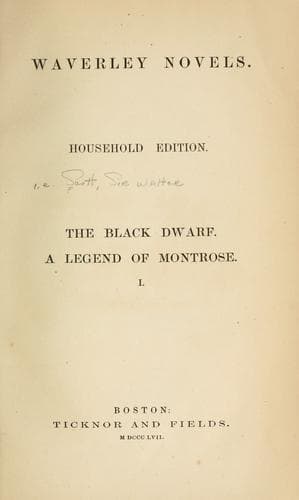
Historical fiction; Montrose, James Graham, Marquis of, 1612-1650 -- Fiction; Scotland -- History -- Charles I, 1625-1649 -- Fiction
Our DRAMATIS PERSONAE have been so limited, that, excepting Montrose,
whose exploits and fate are the theme of history, we have only to
mention Sir Dugald Dalgetty. This gentleman continued, with the most
rigorous punctuality, to discharge his duty, and to receive his pay,
until he was made prisoner, among others, upon the field of Philiphaugh.
He was condemned to share the fate of his fellow-officers upon that
occasion, who were doomed to death rather by denunciations from the
pulpit, than the sentence either of civil or military tribunal; their
blood being considered as a sort of sin-offering to take away the guilt
of the land, and the fate imposed upon the Canaanites, under a special
dispensation, being impiously and cruelly applied to them.
Several Lowland officers, in the service of the Covenanters, interceded
for Dalgetty on this occasion, representing him as a person whose skill
would be useful in their army, and who would be readily induced to
change his service. But on this point they found Sir Dugald unexpectedly
obstinate. He had engaged with the King for a certain term, and,
till that was expired, his principles would not permit any shadow of
changing. The Covenanters, again, understood no such nice distinction,
and he was in the utmost danger of falling a martyr, not to this or that
political principle, but merely to his own strict ideas of a military
enlistment. Fortunately, his friends discovered, by computation, that
there remained but a fortnight to elapse of the engagement he had
formed, and to which, though certain it was never to be renewed, no
power on earth could make him false. With some difficulty they procured
a reprieve for this short space, after which they found him perfectly
willing to come under any engagements they chose to dictate. He entered
the service of the Estates accordingly, and wrought himself forward to
be Major in Gilbert Ker’s corps, commonly called the Kirk’s Own Regiment
of Horse. Of his farther history we know nothing, until we find him in
possession of his paternal estate of Drumthwacket, which he acquired,
not by the sword, but by a pacific intermarriage with Hannah Strachan,
a matron somewhat stricken in years, the widow of the Aberdeenshire
Covenanter.
Sir Dugald is supposed to have survived the Revolution, as traditions
of no very distant date represent him as cruising about in that country,
very old, very deaf, and very full of interminable stories about the
immortal Gustavus Adolphus, the Lion of the North, and the bulwark of
the Protestant Faith.
*****
READER! THE TALES OF MY LANDLORD ARE NOW FINALLY CLOSED, closed, and
it was my purpose to have addressed thee in the vein of Jedediah
Cleishbotham; but, like Horam the son of Asmar, and all other imaginary
story-tellers, Jedediah has melted into thin air.
Public-domain text, read in full here on John Shaqi.
Reviews
Reviews
No reviews yet
Be the first to share your thoughts on this work.
Elsewhere in the archive
Join the Discussion
Join the discussion
Sign in to leave a comment or review.
Sign InorCreate an account