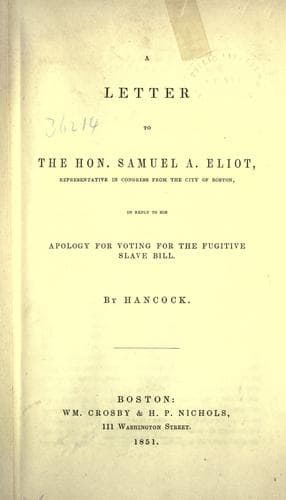
A Letter to the Hon. Samuel A. Eliot, Representative in Congress From the City of Boston, In Reply to His Apology For Voting For the Fugitive Slave Bill.Dexter, Franklin
Philosophy
A Letter to the Hon. Samuel A. Eliot, Representative in Congress From the City of Boston, In Reply to His Apology For Voting For the Fugitive Slave Bill.
Dexter, Franklin
Eliot, Samuel Atkins, 1798-1862; Fugitive slave law of 1850; Slavery -- United States
In this universal panic, in this dread entertained, especially in
Boston, by Mr. Webster's friends, of soon seeing the mighty fabric of
our government trembling over their heads, it may, Sir, be consolatory
to you and others to know how so dire a calamity may be averted. The
chivalric Senator from Mississippi--the gentleman who threatens to hang
one Senator if he dare place his foot on the soil of Mississippi, who
draws a loaded pistol on another, and for a third bears a challenge to
mortal combat--was lately in the city of New York. The Committee of
Safety found him out, and lauded him for his fearless discharge of duty,
and his fervor and devotion to the Union, and welcomed him to the
commercial emporium in the name of all who appreciate the blessings we
enjoy, and are willing to transmit them to their children. The worthy
and conciliatory gentleman very appropriately communicated to the
committee having the Union in charge the conditions on which alone it
could be saved, notwithstanding its bond had so recently been
strengthened. These conditions are, we learn, four in number.
1. "The Fugitive Slave Bill passed by Congress shall remain the law of
the land, and be faithfully executed."
Both you and Mr. Webster admit that the Constitution permits a jury
trial to the fugitive. Should Congress, in its wisdom, and in obedience
to the wishes of the great mass of the Northern population, and in the
exercise of its constitutional power, elevate property in a human being
to the same level with that in a horse, and permit a jury to pass upon
the title to it,--_the Union must be dissolved_.
2. "The Wilmot Proviso, that monstrous thing, shall not be revived." It
was not courteous, certainly, in Mr. Foote thus to characterize Mr.
Webster's thunder. The claim to this thunder was made in his speech,
September, 1847, at the Springfield Convention, which nominated him for
President; and the Convention, in his presence, thus declared their
devotion to his missile. "The Whigs of Massachusetts now declare, and
put this declaration of their purpose _on record_, that Massachusetts
will never consent that Mexican territories, however acquired, shall
become a part of the American Union, unless on the _unalterable_
condition that there shall be neither slavery nor involuntary servitude,
otherwise than in punishment for crime." The next year Mr. Webster
launched his thunder over the Territory of Oregon, and thus in his
speech (10th August, 1848) vindicated it from the character now given to
it by Mr. Foote:--
Public-domain text, read in full here on John Shaqi.
Reviews
Reviews
No reviews yet
Be the first to share your thoughts on this work.
Join the Discussion
Join the discussion
Sign in to leave a comment or review.
Sign InorCreate an account