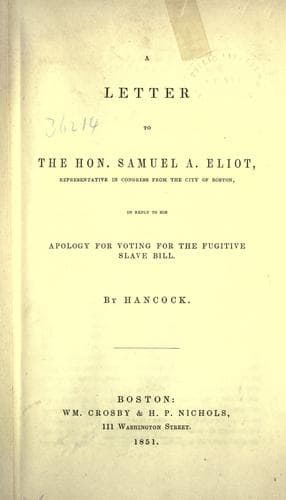
A Letter to the Hon. Samuel A. Eliot, Representative in Congress From the City of Boston, In Reply to His Apology For Voting For the Fugitive Slave Bill. — John Shaqi
A Letter to the Hon. Samuel A. Eliot, Representative in Congress From the City of Boston, In Reply to His Apology For Voting For the Fugitive Slave Bill.Dexter, Franklin
Philosophy
A Letter to the Hon. Samuel A. Eliot, Representative in Congress From the City of Boston, In Reply to His Apology For Voting For the Fugitive Slave Bill.
Dexter, Franklin
Eliot, Samuel Atkins, 1798-1862; Fugitive slave law of 1850; Slavery -- United States
How far the clouds which hovered over our house have been dissipated,
let the recent rout of Mr. Webster's party in Massachusetts testify. Let
his own declaration, a month after the _peace_ measures were adopted,
that the Union was passing through a _fiery trial_, testify.[4] How far
the work of the two days has fortified the Constitution, let the recent
law of Vermont, denounced as an utter nullification of the Constitution,
because it rescues the alleged fugitive from the hands of the
commissioner, and gives him a jury trial before a State court, testify.
When rumors were rife that Mr. Webster intended to repudiate his own
thunder, the Wilmot Proviso, the _New York Herald_, the chief Northern
organ of the slaveholders, promised that, if the Senator would indeed
pursue a course so patriotic, a grateful country would, at the next
election, place him in the Presidential chair. But scarcely had the acts
advocated by Mr. Webster been consummated, than the _Herald_, with
sardonic malice, announces,--"The predictions of Mr. Clay, that the
Compromise Bill would speedily conciliate all parties, and restore the
era of good feeling, were exactly the reverse of the actual
consequences. Mr. Webster has been cast overboard in Massachusetts.
General Cass has been virtually condemned in Michigan. Mr. Dickinson,
the President, and his cabinet, have been routed in New York. Mr. Phelps
has been superseded in Vermont. Whilst in Ohio, Illinois, Iowa, and
Wisconsin, the Free-Soilers have carried off the booty." And he winds up
with declaring, that the next President "can't be Fillmore nor Webster."
[4] Letter to Union Meeting in New York, 28th Oct., 1850.
If the "peace measures" have strengthened the bond of the Union, what
mean all the meetings lately held to _save the Union_? Why is the tocsin
now sounded by the very authors and friends of the measures? How comes
it that, in Boston itself, the chairman of a Union meeting contradicts
the exulting and jubilant shout of triumph uttered by the Secretary of
State, and makes the following doleful announcement:--"The Union, and
consequently the existence of this nation, is menaced, and unless there
is a great and general effort in their support, we may soon behold the
mighty fabric of our government trembling over our heads, and
threatening by its fall to crush the prosperity which we have so long
and happily enjoyed." So relaxed has become the bond of our Union, that
one hundred gentlemen of property and standing in New York have, under
the style and title of "The New York Union Committee of Safety," assumed
the onerous task of taking it into their safe-keeping. "Committees of
safety" are associated with times of peril and anarchy, and are never
wanted when alarms have ceased, angry discussions ended, the
Constitution fortified, and the bond of union strengthened.
Public-domain text, read in full here on John Shaqi.
Reviews
Reviews
No reviews yet
Be the first to share your thoughts on this work.
Join the Discussion
Join the discussion
Sign in to leave a comment or review.
Sign InorCreate an account