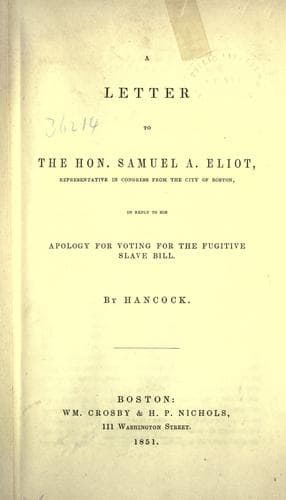
A Letter to the Hon. Samuel A. Eliot, Representative in Congress From the City of Boston, In Reply to His Apology For Voting For the Fugitive Slave Bill.Dexter, Franklin
Philosophy
A Letter to the Hon. Samuel A. Eliot, Representative in Congress From the City of Boston, In Reply to His Apology For Voting For the Fugitive Slave Bill.
Dexter, Franklin
Eliot, Samuel Atkins, 1798-1862; Fugitive slave law of 1850; Slavery -- United States
"Gentlemen from the South declare that we invade their rights when we
deprive them of a participation in the enjoyment of territories acquired
by the common services and common exertions of all. Is this true? Of
what do we deprive them? Why, they say that we deprive them of the
privilege of carrying their slaves as slaves into the new territories.
Well, Sir, what is the amount of that? They say, that in this way we
deprive them of going into this acquired territory with their property.
Their property! What do they mean by this 'property'? We certainly do
not deprive them of the privilege of going into those newly acquired
territories with all that, in the general estimate of human society and
common and universal understanding of mankind, is esteemed property. Not
at all. The truth is just this. They have in their own States peculiar
laws which create property in persons.... The real meaning, then, of
Southern gentlemen, in making this complaint, is, that they cannot go
into the territories of the United States carrying with them their own
peculiar law, a law which creates property in persons."
So the Wilmot Proviso was no monstrous thing at all, as applied to
Oregon. When the question came up of applying this same Proviso to New
Mexico and California, Mr. Webster discovered in these Territories a
certain peculiarity of physical geography and Asiatic scenery which he
had not discovered in Oregon, and which, he found, rendered it a
physical impossibility for Southern gentlemen to carry there "a law
which creates property in persons," and he therefore gave them full
liberty to carry their law into those vast regions, if they could. But
at the very moment of giving this liberty to Southern gentlemen, he
courageously warned them that his thunder was good constitutional
thunder, and would be used whenever necessary. "Wherever there is an
_inch of land_ to be stayed back from becoming slave territory, I am
ready to insert the principle of the exclusion of slavery. I am pledged
to that from 1837,--pledged to it again and again, and I will perform
those pledges." So, should we get another slice of Mexico, or annex Cuba
or St. Domingo, Mr. Webster would revive the Wilmot Proviso, and then
_he_ will be the means, if he succeeds, of dissolving the Union!
3. The next condition announced to the Safety Committee is,--"No attempt
shall be made in Congress to prohibit slavery in the District of
Columbia."
Public-domain text, read in full here on John Shaqi.
Reviews
Reviews
No reviews yet
Be the first to share your thoughts on this work.
Join the Discussion
Join the discussion
Sign in to leave a comment or review.
Sign InorCreate an account