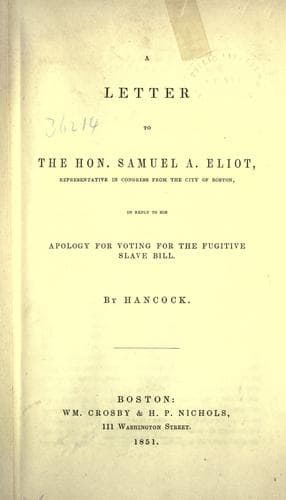
A Letter to the Hon. Samuel A. Eliot, Representative in Congress From the City of Boston, In Reply to His Apology For Voting For the Fugitive Slave Bill. — John Shaqi
A Letter to the Hon. Samuel A. Eliot, Representative in Congress From the City of Boston, In Reply to His Apology For Voting For the Fugitive Slave Bill.Dexter, Franklin
Philosophy
A Letter to the Hon. Samuel A. Eliot, Representative in Congress From the City of Boston, In Reply to His Apology For Voting For the Fugitive Slave Bill.
Dexter, Franklin
Eliot, Samuel Atkins, 1798-1862; Fugitive slave law of 1850; Slavery -- United States
Now it is the opinion of Mr. Webster, that Congress has the
constitutional right, not merely to attempt, but actually to effect, the
exclusion of slavery in _all_ the Territories of the United States. The
District of Columbia being placed by the Constitution expressly under
"the exclusive jurisdiction" of Congress, the _constitutional_ right to
abolish slavery there has rarely been questioned; but it has been
contended that good faith to the States which ceded the District forbids
such an act of constitutional power. Hence, in 1838, a resolution was
introduced into the Senate declaring that the abolition of slavery in
the District would be "a violation of good faith," &c. What said Mr.
Webster? "I do not know any matter of fact, or any ground of argument,
on which this affirmation of plighted faith can stand. I see nothing in
the act of cession, and nothing in the Constitution, and nothing in the
transaction, implying any limitation on the authority of Congress."[5]
[5] On the 10th of January, 1838, Mr. Clay moved in the Senate the
following resolution, viz.:--"Resolved, that the interference by the
citizens of any of the States with a view to the abolition of slavery in
this District, is endangering the rights and security of the people of
this District; and that any act or measure of Congress designed to
abolish slavery in this District would be a violation of the faith
implied in the cession by the States of Virginia and Maryland, a just
cause of alarm to the people of the slaveholding States, and have a
direct and inevitable tendency to disturb and endanger the
Union."--Passed, 38 to 8, Mr. Webster voting in the negative. _Senate
Journal_, _2 Sess. 25 Cong._, p. 127.
Public-domain text, read in full here on John Shaqi.
Reviews
Reviews
No reviews yet
Be the first to share your thoughts on this work.
Join the Discussion
Join the discussion
Sign in to leave a comment or review.
Sign InorCreate an account