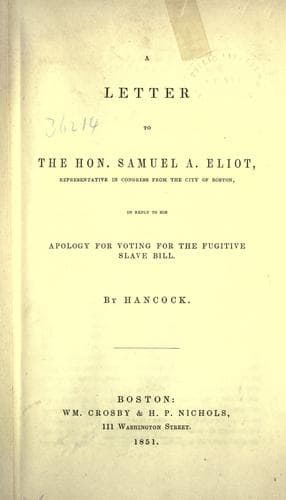
A Letter to the Hon. Samuel A. Eliot, Representative in Congress From the City of Boston, In Reply to His Apology For Voting For the Fugitive Slave Bill.Dexter, Franklin
Philosophy
A Letter to the Hon. Samuel A. Eliot, Representative in Congress From the City of Boston, In Reply to His Apology For Voting For the Fugitive Slave Bill.
Dexter, Franklin
Eliot, Samuel Atkins, 1798-1862; Fugitive slave law of 1850; Slavery -- United States
It would seem, Sir, that, in the late treaty of peace between the North
and the South, it has been agreed and understood, that every power
granted by the Constitution, whereby slavery can be protected, extended,
and perpetuated, is to be actively enforced; and that every power which
might be used for curtailing human bondage, however unquestionable may
be its grant, shall for ever remain dormant, under the penalty of an
immediate dissolution of the Union. This, Sir, is the treaty which our
commercial cities are glorifying; this is the treaty which has turned
our "winter of discontent" into "glorious summer." And think you, Sir,
that the slaveholders, having eyes, see not, and having understandings,
perceive not, the haberdashery patriotism which rejoices in such a
treaty, and denounces as "fanatics," "vipers," and "woolly-headed
philanthropists," all who do not confess it to be a glorious
consummation? The Southern papers tell us that our Union meetings are
got up to "sell a little more tape and flannel"; and they remark, "It is
very queer that Union meetings are held only in places which trade with
the South." Out of regard to their Southern brethren, a member of the
British House of Commons was insulted in Faneuil Hall by a portion of
the Boston people, and forthwith the _New Orleans Delta_, instead of
gratefully acknowledging the compliment, remarks, that their "good
Union-loving friends in Boston are now solacing the South with
sugar-plums in the shape of resolutions and speeches, and spice in the
form of a row, got up on the occasion of the first appearance of George
Thompson, an imported incendiary and hireling agitator. Such
manifestation possesses an advantage which doubtless constitutes no
small recommendation with our good brethren of Boston,--it is very
cheap. The _cottoncratical_ clerks and warehousemen may raise a hubbub
in Faneuil Hall, but the fanatics can slay them at the _polls_."
It is some consolation to those who are now suffering all the contempt
and opprobrium which can be thrown both upon their heads and their
hearts, because they have refused to follow Mr. Webster in the devious
paths in which it has lately been his pleasure to walk, that they have
by their constancy and firmness extorted from their Southern antagonists
a tribute which is not paid to their revilers. Said Mr. Stanley, of
Virginia, in his speech in the House of Representatives last March,
speaking of a certain class of Northern politicians,--"I would say, with
a slight alteration of one of Canning's verses,--
'Give me the avowed, erect, and manly foe,
Open I can meet, perhaps may turn, his blow;
But of all the plagues, great Heaven, thy wrath can send,
Save, O, save me from a _dough-face friend_!'"
Public-domain text, read in full here on John Shaqi.
Reviews
Reviews
No reviews yet
Be the first to share your thoughts on this work.
Join the Discussion
Join the discussion
Sign in to leave a comment or review.
Sign InorCreate an account