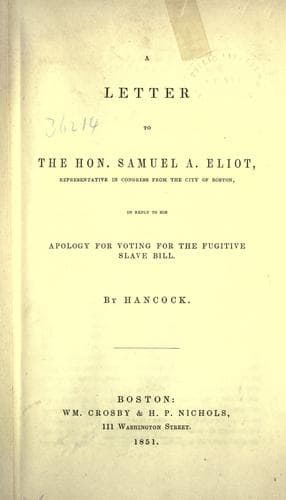
A Letter to the Hon. Samuel A. Eliot, Representative in Congress From the City of Boston, In Reply to His Apology For Voting For the Fugitive Slave Bill.Dexter, Franklin
Philosophy
A Letter to the Hon. Samuel A. Eliot, Representative in Congress From the City of Boston, In Reply to His Apology For Voting For the Fugitive Slave Bill.
Dexter, Franklin
Eliot, Samuel Atkins, 1798-1862; Fugitive slave law of 1850; Slavery -- United States
Mr. Webster declared, that the work of the two days in which he rejoiced
had fortified the Constitution, and strengthened the bond of the Union;
and yet we are now solemnly warned, by the very men and party with whom
he is acting, that the bond is to be severed, should Congress pass any
one of five laws, all and each of which he, the great expounder,
declares the Constitution authorizes Congress to pass. So it seems the
great peril to which we are exposed, the course which is to make the
fabric of our government to tremble over the heads of the people of
Boston, is, not the violation of the Constitution, nor the breach of its
compromises, nor the invasion of the rights of the South, but the
exercise by Congress of powers which Mr. Webster declares to be
undoubtedly constitutional. The Abolitionists supposed they were
following a safe guide when they confined themselves, in their petitions
to Congress for legislative action against slavery, exclusively to such
measures as they were assured, by the eminent expounder, were strictly
constitutional. The Abolitionists have sympathized with this gentleman
in the obloquy he incurred, in common with themselves, for holding
opinions unpalatable to the slaveholders, and for maintaining the
constitutional rights of Congress. Because he insisted, in the Senate,
on the power of Congress over slavery and the slave-trade in the
District of Columbia, Mr. Rives, of Virginia, was so unkind as to say,
that the gentleman from Massachusetts, "if it so pleased his fancy,
might disport himself in tossing squibs and firebrands about this hall;
but those who are sitting upon a barrel of gunpowder, liable to be blown
up by his dangerous missiles, could hardly be expected to be quite as
calm and philosophic." Because he presented antislavery petitions, and
insisted on the duty of Congress to consider them, Mr. King, of Alabama,
affirmed that the course which the Senator from Massachusetts had taken
had "placed him at the head of those men who are inundating Congress
with their petitions." Strange as it may now seem, Mr. Cuthbert, of
Georgia, told Mr. Webster to his face in the Senate, "The gentleman had
uniformly been opposed to all those measures which tended to quiet the
country and heal those sectional dissensions which distract the
Union."[6] Surely, when the Abolitionists have so long made Mr. Webster
their polar star in all constitutional questions, and have incurred with
him the accusation of tossing squibs and firebrands, and of opposing
measures which tended to quiet the country and settle sectional
dissensions, they had a right to expect from his friends a larger share
of compassion and forbearance than they have experienced.
[6] Speech, June 8, 1836.
Public-domain text, read in full here on John Shaqi.
Reviews
Reviews
No reviews yet
Be the first to share your thoughts on this work.
Join the Discussion
Join the discussion
Sign in to leave a comment or review.
Sign InorCreate an account