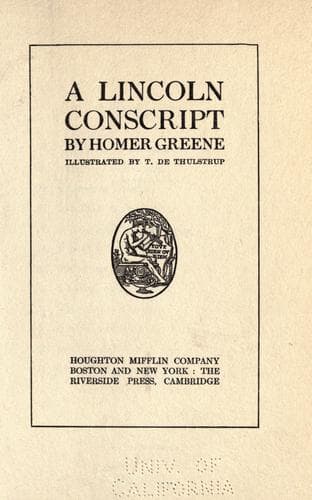
Lincoln, Abraham, 1809-1865 -- Juvenile fiction; United States -- History -- Civil War, 1861-1865 -- Juvenile fiction
And the captain gave heed to his protest, knowing that it came from his
heart; and so he continued to fight in the ranks, honored, trusted,
and loved by all his comrades. In the midst of the political campaign
of ’64, when the contest for the office of President of the United
States was stirring the North as no political contest had ever stirred
it before; when Lincoln’s enemies felt that they had won the victory,
and that the battle of the ballots on election day would only ratify
it; when Lincoln himself gave up the hope that he would be permitted
to lead the nation back to peace and safety; when only the votes of
the soldiers in the field could by any possibility save the day, Rhett
Bannister turned politician and went out electioneering. From man
to man he went, from company to company, from regiment to regiment,
earnest, anxious, persuasive, pleading with his whole heart and soul
the cause of Abraham Lincoln. And when the November ballots were
counted, and the overwhelming majority proved that the people in the
North as well as the soldiers in the field had confidence in the great
War President, no heart in the Army of the Potomac beat with more
exultant pride and unbounded happiness than did the heart of Rhett
Bannister, the Lincoln conscript.
In March came the President’s second inaugural address. A newspaper
containing a report of it floated early into camp and came into
Bannister’s hands. He read the address word by word, sentence by
sentence again and again. Then he called together the men who were fond
of listening to him and read it to them.
“You will not find,” he said, “in all history, nor in all literature,
a clause so sublime in thought, so simple in diction, so sweet with
divine charity as this; listen: ‘With malice toward none, with charity
for all, with firmness in the right as God gives us to see the right,
let us strive to finish the work we are in; to bind up the nation’s
wounds; to care for him who shall have borne the battle, and for his
widow and his orphan; to do all which may achieve and cherish a just
and lasting peace among ourselves and with all nations.’
“Gentlemen, that is Abraham Lincoln, than whom no man who ever lived
in America has had a higher aim, a sweeter spirit, or a more prophetic
vision.”
Public-domain text, read in full here on John Shaqi.
Reviews
Reviews
No reviews yet
Be the first to share your thoughts on this work.
Elsewhere in the archive
Join the Discussion
Join the discussion
Sign in to leave a comment or review.
Sign InorCreate an account