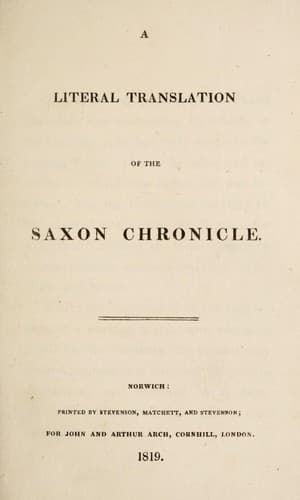
Great Britain -- History -- Anglo-Saxon period, 449-1066 -- Sources
Then was corn dear, and flesh, and cheese, and butter, for there was
none in the land--wretched men starved with hunger--some lived on alms
who had been erewhile rich: some fled the country--never was there
more misery, and never acted heathens worse than these. At length
they spared neither church nor churchyard, but they took all that was
valuable therein, and then burned the church and all together. Neither
did they spare the lands of Bishops, nor of Abbots, nor of Priests;
but they robbed the monks and the clergy, and every man plundered
his neighbour inasmuch as he might. If two or three men came riding
to a town, all the township fled before them, and thought that they
were robbers. The Bishops and clergy were ever cursing them, but this
to them was nothing, for they were all accursed, and forsworn, and
reprobate. The earth bare no corn, you might as well have tilled the
sea, for the land was all ruined by such deeds, and it was said openly
that Christ and his Saints slept. These things, and more than we can
say, did we suffer during 19 years because of our sins. Through all
this evil time the Abbot Martin held his Abbacy for 20 years, and a
half, and eight days, with many difficulties: and he provided the
monks and guests with all necessaries, and kept up much alms in the
house; and withal he wrought upon the church, and annexed thereto lands
and rents, and enriched it greatly, and furnished it with robes: and
he brought the monks into the new monastery on St. Peter’s day with
much pomp. This was in the year 1140 of our Lord’s incarnation, the
23d year after the fire. And he went to Rome and was well received
there by Pope Eugenius, and he obtained sundry privileges, to wit, one
for all the abbey lands, and another for the lands that adjoin the
monastery, and had he lived longer he meant to have done as much for
the treasurer’s house. And he regained certain lands that powerful
men possessed by force; he won Cottingham and Easton from William
Malduit, who held Rockingham castle, and from Hugh of Waltville he won
Hyrtlingberi (Artleborough), and Stanwick, and sixty shillings yearly
out of Aldewingle (Oldwincle). And he increased the number of monks,
and planted a vineyard, and made many works, and improved the town; and
he was a good monk and a good man, and therefore God and good men loved
him.--Now will we relate some part of what befel in King Stephen’s
time. In his reign the Jews of Norwich bought a Christian child before
Easter, and tortured him with all the torments wherewith our Lord was
tortured, and they crucified him on Good Friday for the love of our
Lord, and afterwards buried him. They believed that this would be kept
secret, but our Lord made manifest that he was a holy martyr, and the
monks took him and buried him honourably in the monastery, and he
performed manifold and wonderful miracles through the power of our
Lord, and is called St. William.
1138.
Public-domain text, read in full here on John Shaqi.
Reviews
Reviews
No reviews yet
Be the first to share your thoughts on this work.
Elsewhere in the archive
Join the Discussion
Join the discussion
Sign in to leave a comment or review.
Sign InorCreate an account