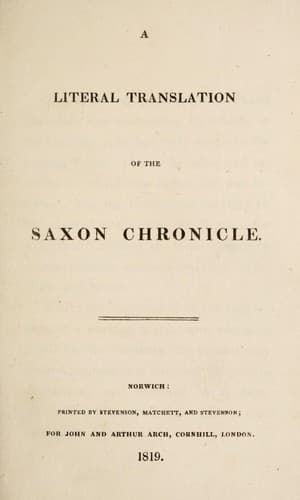
Great Britain -- History -- Anglo-Saxon period, 449-1066 -- Sources
This year the Deacon Wulfstan died, on Childermas-day, and after this
died Cyric the Priest. The same year the Abbot Athelwold received the
Bishoprick of Winchester, and was consecrated on a Sunday, the vigil
of St. Andrew. The second year after his consecration be founded many
monasteries, and he drove the clergy out of his bishoprick because they
would observe no rule, and he placed monks in their room. He founded
two abbeys, one for monks, the other for nuns, both in Winchester.
Afterwards he went to King Edgar, and desired of him that he would give
him all the monasteries which the heathens had destroyed, for that
he would restore them; and the King willingly granted his request.
And the Bishop came first to Ely, where. St. Ætheldrith lieth, and
he caused the monastery to be rebuilt, and he gave it to one of his
monks named Brihtnoth. He consecrated him abbot, and he established
monks there to serve God, whereas the place was formerly inhabited by
nuns, and he bought many small estates of the King, and made it very
rich. Afterwards Bishop Athelwold came to the monastery that is called
Medeshamstede, which had been destroyed by the heathens, and he found
nothing there but old walls and wild woods. He found also hidden in
the old wall the records which the abbot Headda had formerly written,
how King Wulfhere and his brother Æthelred had built the monastery,
and had made it free of the King, of the Bishop, and of all earthly
service; and how the Pope Agatho had confirmed this with his rescript,
and the Archbishop Deusdedit also. He then caused the monastery to
be rebuilt, and he appointed an abbot whose name was Aldulf, and he
peopled that place with monks, which was before a wilderness. Then he
came to the King, and caused him to look at the writings which had
been found, and the King then answered and said, “I King Edgar, before
God and in presence of the Archbishop Dunstan, do this day grant to
St. Peter’s monastery of Medeshamstede, freedom from subjection to
the King and to the Bishop, and do endow it with all these adjoining
villages, to wit, Æst-feld (Eastfield), and Dodes-thorp (Dasthorp), and
Ege (Eye), and Pastun (Paston). And I so make it free, that no Bishop
shall have any authority over it, but the abbot of the monastery alone.
And I give the town called Undela (Oundle) with all the land belonging
to it, which is called the Eahte hundred, with the markets and tolls,
so freely, that neither the King, nor the Bishop, nor the Earl,
nor the Sheriff of the county, shall have any power there, neither
any man, excepting the abbot alone, and those whom he may appoint
thereto. And at the request of Bishop Athelwold, I give these lands
to Christ and to St. Peter, to wit, Barwe (Barrow or Berk, Rutland),
Wermington (Warmington, Northamptonshire), Æsctun (Ashton, near
Oundle?), Kettering, Castra (Castor, Northamptonshire), Egleswurthe
(Ailesworth), Walton, Withringtun (Werrington), Ege (Eye), Thorp (near
Public-domain text, read in full here on John Shaqi.
Reviews
Reviews
No reviews yet
Be the first to share your thoughts on this work.
Elsewhere in the archive
Join the Discussion
Join the discussion
Sign in to leave a comment or review.
Sign InorCreate an account