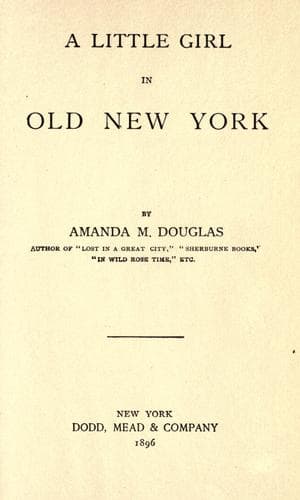
New York (N.Y.) -- History -- 1775-1865 -- Fiction
They took Aunt Eunice a walk down Broadway to show her the sights. The
"dollar side" had become the accepted promenade. Already there were some
quite notable people who were pointed out to visitors. You could see Mr.
N. P. Willis, who was then at the zenith of his fame. When a
Sunday-school entertainment wanted to give something particularly fine,
the best speaker recited his poem, "The Leper," which was considered
very striking. There was Lewis Gaylord Clark, of _The Knickerbocker_,
who wrote charming letters, and these two were admitted to be very
handsome men. There was George P. Morris, whose songs were sung
everywhere, and not a few literary ladies. There was the Broadway swell
in patent-leather boots and trousers strapped tightly down, in the style
the boys irreverently called pegtops. He had a high-standing collar, a
fancy tie, a light silk waistcoat with a heavy watch-chain and seal, a
coat with large, loose sleeves, a high hat, and carried his cane under
his arm, while, as one of the writers of the day said, "he ambled along
daintily."
Then you might meet the Hammersley carriage with its footman and livery
that had made quite a talk. Young and handsome Mrs. Little, whose
marriage to an old man had been the gossip of the season, sat in elegant
state with her coachman in dark blue. Now one hardly notes the handsome
equipages, or the livery either.
But the "Bowery boy" was as great a feature of the time as the Broadway
swell. He, too, wore a silk hat, and it generally had a three-inch
mourning band. His hair was worn in long, well-oiled locks in front,
combed up with a peculiar twist. He wore a broad collar turned over, and
a sailor tie, a flashy vest with a large amount of seal and chain, and
wide trousers turned up. His coat he carried on his arm when the weather
permitted, and he always had a cigar in the lower corner of his mouth.
He walked with a swagger and a swing that took half the sidewalk. He ran
"wid de machine," and a fire was his delight; to get into a fight his
supreme happiness. He really did not frequent the Bowery so much as the
side streets. There were little stores where cigars and beer were sold,
something stronger perhaps, and they were generally kept by some old
lady who could also get up a meal on a short notice after a fire. On
summer nights they had chairs out in front of the door, and tilting back
on two legs would smoke and take their comfort. For diversion they went
to Vauxhall Garden or the pit of the Bowery Theatre. Yet they were quite
a picturesque feature of old New York.
Bowery and Grand Street were the East Side's shopping marts. Stewart was
building a marble palace at the corner of Broadway and Chambers Street.
You went to Division and Canal streets for your bonnets. There were a
few private milliners who made to order and imported.
Public-domain text, read in full here on John Shaqi.
Reviews
Reviews
No reviews yet
Be the first to share your thoughts on this work.
Elsewhere in the archive
Join the Discussion
Join the discussion
Sign in to leave a comment or review.
Sign InorCreate an account