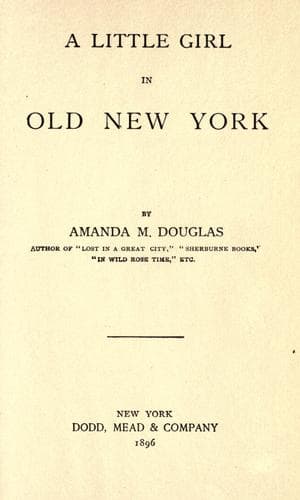
New York (N.Y.) -- History -- 1775-1865 -- Fiction
When the exercises were finished the children were all taken down-stairs
and they looked very pretty flitting about. There was another surprise,
one that greatly interested the little girl. In one prettily arranged
booth were two curious small beings who had a history. They had already
been in Sunday-school on two occasions. A missionary to China, seeing
these little girls about to be sold, had rescued them by buying them
himself. He had brought them back on his return, and now kindly disposed
people were making up a sum to provide them with a home and educate
them.
Hanny pressed forward holding John's hand tightly. They were so
strange-looking. The larger and older one was not at all pretty, but the
younger one had a sweet sort of shyness and was not so stolid. Their
yellow-brown skins, oblique dark eyes, black brows, and black hair done
up in a remarkable fashion with some long pins, and their Chinese attire
seemed very curious. The gentleman with them said there were hundreds
of little girls sold in China, and that women bought them for future
wives for their sons, and treated them like bond slaves. These
children's feet had not been cramped, this was done mainly to the higher
orders. He had some Chinese shoes worn by grown women, and they were
such short, queer things, like some of the pincushions made for the
Fair.
We didn't suppose then the Chinese would come and live with us and have
a Chinatown in the heart of the city; do our laundry work and take
possession of our kitchens; that the blue shirts and queer pointed shoes
would be a common sight in our streets. So the Chinese children were a
curiosity. Indeed, several years elapsed before Hanny saw another
inhabitant of the Flowery Kingdom.
"Don't you want to put something in the box?" John held out a quarter to
the little girl.
Her eyes sparkled with pleasure. Then she shook hands with the small
Chinese maidens, and she felt almost as if she had been to a foreign
country.
If Mrs. Reed had been present she would have marched Charles home in
short order. She did not believe in praising children, or anybody else
for that matter. Everybody, in her opinion, needed a strict hand. She
hardly approved of the singing-school, and if she had really understood
that Charles would stand out alone facing the audience, and then be
applauded for what he had done, and go into the fair and be praised and
"treated," she would have been horrified and put him on the strictest
sort of discipline for the next month.
Charles had endeavored to persuade his mother to go, but she wanted to
get the turkey ready for the Christmas dinner, and had no time for such
trifling things. No woman had who did her duty by her house and her
family. The harder and stonier and more rigid the discipline was, the
more virtue it contained, she thought. There was no especial end in view
with her; it was the way all along that one had to be careful about and
make as rough as possible.
Public-domain text, read in full here on John Shaqi.
Reviews
Reviews
No reviews yet
Be the first to share your thoughts on this work.
Elsewhere in the archive
Join the Discussion
Join the discussion
Sign in to leave a comment or review.
Sign InorCreate an account