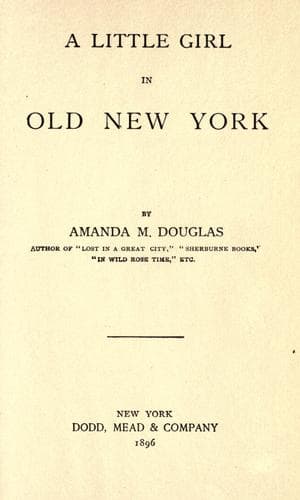
New York (N.Y.) -- History -- 1775-1865 -- Fiction
That summer political excitement ran high. Indeed, it had begun in the
winter. A new party had nominated Mr. James Harper for mayor, and in
the spring he had been elected. Mr. Theodore used to pause and discuss
men and measures now that it was getting warm enough to sit out on the
stoop and read your paper. Country habits were not altogether tabooed.
But what impressed his honor the mayor most strongly on the little
girl's mind was something Aunt Nancy Archer, who was now an earnest
Methodist, said when she was up to tea one evening.
"I did look to see Brother Harper set up a little. It's only natural,
you know, and I can't quite believe in perfection. But there he was in
class-meeting, not a mite changed, just as friendly and earnest as ever,
not a bit lifted up because he had been called to the highest position
in the city."
"There's no doubt but he will make a good mayor," rejoined Mr.
Underhill. "He's a good, honest man. And all the brothers are capable
men, men who are able to pull together. I'm not sure but we'll have to
go outside of party lines a little. It ought to broaden a man to be in a
big city."
The little girl slipped her hand in Aunt Nancy's.
"Is he your school-teacher?" she ventured timidly.
"School-teacher? Why, no, child!" in surprise.
"You said class----"
"You'll have to be careful, Aunt Nancy. That little girl has an
inquiring mind," laughed her father.
"Yes. It's a church class. I belong to the same church as Brother
Harper. We're old-fashioned Methodists. We go to this class to tell our
religious experiences. You are not old enough to understand that. But we
talk over our troubles and trials, and tell of our blessings too, I
hope, and then Brother Harper has a good word for us. He comforts us
when we are down at the foot of the hill, and he gives us a word of
warning if he thinks we are climbing heights we're not quite fitted for.
He makes a comforting prayer."
"I should like to see him," said the little girl.
"Well, get your father to bring you down to church some Sunday. Do,
Vermilye."
"Any time she likes," said her father.
They talked on, but Hanny went off into a little dreamland of her own.
She was not quite clear what a mayor's duty was, only he was a great
man. And her idea of his not being set up, as Aunt Nancy had phrased it,
was that there was a great handsome chair, something like a throne, that
had been arranged for him, and he had come in and taken a common seat.
She was to have a good deal of hero-worship later on, and be roused and
stirred by Carlyle, but there was never anything finer than the
admiration kindled in her heart just then.
After Aunt Nancy went away she crept into her father's lap.
"Aren't you glad Mr. Harper's our mayor?" she asked. "Did everybody vote
for him? Do girls--big girls--and women vote?"
"No, dear. Men over twenty-one are the only persons entitled to vote.
Steve and Joe and I voted. And it's too bad, but John can't put in his
vote for President this fall."
Public-domain text, read in full here on John Shaqi.
Reviews
Reviews
No reviews yet
Be the first to share your thoughts on this work.
Elsewhere in the archive
Join the Discussion
Join the discussion
Sign in to leave a comment or review.
Sign InorCreate an account