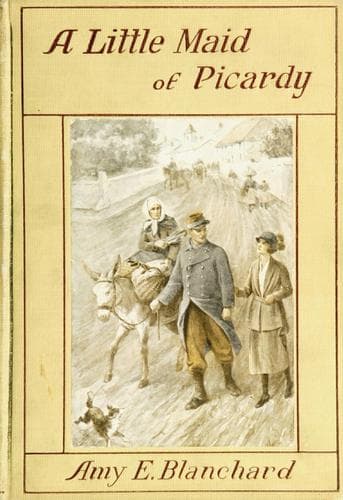
World War, 1914-1918 -- France -- Juvenile fiction
The days lengthened to weeks, the weeks to months, but still the war
continued, while life went on uninterruptedly at _Coin-du-Pres_. During
the time that Victor was slowly creeping back to life and strength at
a distant hospital, Pom Pom in the hands of his friends won out in his
race for health. Long before Victor was able to be on his feet the
little dog was running about quite as if he had never heard of shrapnel
or big guns. To be sure he was a trifle stiff and favored one hind leg
when he ran, but he had full use of three others and was as good as
ever, Lucie declared. If ever a dog was petted and pampered it was he,
though it was always Lucie whom he followed, Lucie whom he wished to
guard.
The good doctor dropped in frequently for a friendly call, a chat with
the girls about Pom Pom, a talk with Mons. Le Brun about the war. Lucie
often listened to the discussions, learning of the sinking of the
_Lusitania_, of the second battle of Ypres, of how the French in the
Champagne failed to pierce the German lines, of Italy as a possible
ally, of the fighting in Russia, in Turkey. The reports of the ups
and downs made the excitement of the days and were discussed by every
one from Michel up. The year 1915 went out with no great encouragement
to the hopes of the Allies; 1916 came in with little promise of sudden
success, but it found the same grim determination in the heart of every
soldier fighting for the Allied cause.
From time to time Lucie saw her father, who could tell them of the
battle of Verdun, assuring them that though the Germans had taken Fort
Douaumont it was through heavy losses, and not large results. This was
in February. In July began the battle of the Somme. It was while it was
in progress that ill news came to Paulette. Jean Ribot was reported
missing.
It was only in the first few moments that Paulette collapsed. Old Jules
brought the news. There had never been very good feeling between him
and Paulette; the latter’s sarcasms were too cutting, but there was
only neighborly sympathy on Jules’ face when he found Paulette out in
the field with Odette and the other workers. The good woman looked
dazed for a moment, then she sank down upon a heap of newly cut hay and
covered her face with her hands. The others stood around in respectful
silence, though shaking their heads at one another and whispering
little prayers.
It was Odette who broke the silence. She stood, slender and firm, with
uplifted head. “If it be true, he has given his best for France,” she
said, “but I do not believe it is true.”
Paulette rose to her feet, wiped her eyes and grasped Odette by the
wrist. “Why, why, do you say that?” she asked in a tense voice.
“That one is missing does not mean that one is dead,” replied Odette.
“He may be a prisoner.”
“Better he were dead,” mourned Paulette, covering her head with her
apron.
Public-domain text, read in full here on John Shaqi.
Reviews
Reviews
No reviews yet
Be the first to share your thoughts on this work.
Elsewhere in the archive
Join the Discussion
Join the discussion
Sign in to leave a comment or review.
Sign InorCreate an account