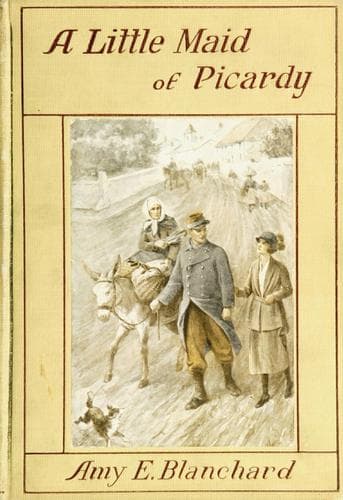
World War, 1914-1918 -- France -- Juvenile fiction
He went off to continue his work of warning. Some of the people at
once began to depart, refugees again; others sought safety in cellars,
dreading a nearer roar of guns and the whistle of shells. Twenty-four
hours of dread. No one slept that night. Who knew when a shell might
come crashing down upon the town? Big Bertha was doing deadly work in
Paris, what might not one expect here?
Then came the morning when out of their houses and cellars flocked
the people. A shout went up. The three in the little new house ran to
the gate. A boy was running up the street waving his arms and crying:
“They’re driven back! They’re driven back! _Vive la France!_”
“We’re safe! We’re safe!” cried Lucie.
“For the moment,” returned Paulette. “I for one do not unpack.”
But though, as time went on, there was a swaying back and forth of the
line, no farther in that direction did the foe advance. Not a shot
fell in the town, and, beyond, the country was peaceful and smiling.
For days those in the little town waited tremblingly the German
advance. Must they be driven out a second time? It seemed almost as if
it must be so for many towns and villages which had been reëstablished
were now being evacuated and the dwellers therein taken farther back to
safety, with all their supplies and even their livestock, much of this
the excellent work of the American Committee for Devastated France. As
time went on and danger threatened more and more, it almost seemed that
the big guns would be directed the next moment upon the town, and that
the bombs would finish the work of destruction begun four years before.
But beyond a certain point the enemy did not penetrate. The fields were
unscathed, the buildings unscarred. The great Juggernaut of war had not
crushed them.
There was much hard fighting, so many lives lost that Lucie at last
came to be thankful that her father was out of it, even though his
might not be an enviable position. At least she might hope that he
would survive and that she could see him again. That veil of silence
still covered her mother, while the Allies were continuing their
triumphant advance, and town after town was liberated.
Then one day the veil was lifted. It was in October. Lucie, with her
pigeons flocking around her, heard a sudden call from Odette. “Come,
come quickly, there are persons coming up the street and I think they
are looking for this house.”
Lucie went to the gate to see two men and a woman approaching. One
was a soldier with an empty sleeve and wearing the French uniform. A
second soldier was plainly an American, and as he came nearer Lucie
distinguished her uncle Philip. The woman she did not recognize at the
first instant, but presently with a wild cry of joy the girl darted out
the gate to throw herself, sobbing hysterically, into the arms of her
very own mother.
Public-domain text, read in full here on John Shaqi.
Reviews
Reviews
No reviews yet
Be the first to share your thoughts on this work.
Elsewhere in the archive
Join the Discussion
Join the discussion
Sign in to leave a comment or review.
Sign InorCreate an account