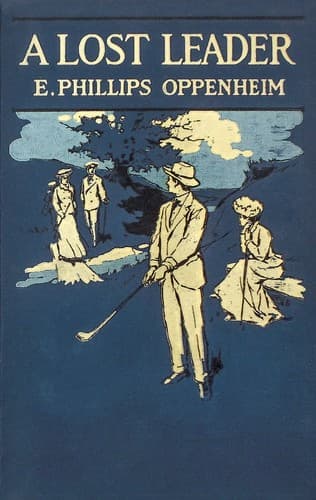
A Lost LeaderOppenheim, E. Phillips (Edward Phillips)
General
A Lost Leader
Oppenheim, E. Phillips (Edward Phillips)
Detective and mystery stories
"Ah!" he murmured, "you, too, are beginning to understand. Happiness is
only for the ignorant. For you and for me knowledge has eaten its way
too far into our lives. We climb all the while, but the flowers in the
meadows are the fairest."
She shook her head.
"The little white flower which grows in the mountains is what we must
always seek," she answered. "The meadows are for the others."
"We are accursed with this knowledge, and the desire for it," he
declared, fiercely. "The suffering is for us, and the joy for the beasts
of the field. Why not throw down the cards? We are the devil's puppets in
this game of life."
"There is no place for us down there," she answered, sadly. "There is joy
enough for them, because the finger has never touched their eyes. But for
us--no, we have to go on! I was a foolish woman, Lawrence. I lost my
sense of proportion. Traditions, you see, were hard to break away from. I
did not understand. Let this be the end of all mention of such things
between us. We have missed the turning, and we must go on. That is the
hardest thing in life. One can never retrace one's steps."
"We go on--apart?"
"We must," she said. "Don't think me prejudiced, Lawrence. I must stand
by my party. Theoretically, I think that you are the only logical
politician I have ever known. Actually, I think that you are steering
your course towards the sandbanks. You will fail, but you will fail
magnificently. Well, that is something."
"It is a good deal," he answered, "but if I live long enough, and my
strength remains, I shall succeed. I shall place the Government of
this country upon an altogether different basis. I shall empty the
work-houses and fill the factories. Nothing short of that will content
me. Nothing short of that would content any man upon whose shoulders the
burden has fallen."
"You have centuries of prejudice to fight," she warned him. "You may not
succeed! Yet you have all my good wishes. I shall always watch you."
They turned homeward in silence. All that had passed between them seemed
to be already far back in the past. Their retrogression seemed almost
symbolical. They spoke of indifferent things.
"Tell me," he asked, "how you came to know what was going on in Leeds."
"It was your wife," she said, "who discovered it!"
"My wife?"
"She saw a telegram on Sir Leslie's table at breakfast, a telegram from
the man Polden. She read it and demanded an explanation. Sir Leslie tried
all he could to wriggle out of it, but in vain. She appealed to me. Even
I had a great deal of difficulty in dealing with him, but eventually he
gave way."
"Then the telegram," Mannering asked, "wasn't that from you?"
She shook her head.
Public-domain text, read in full here on John Shaqi.
Reviews
Reviews
No reviews yet
Be the first to share your thoughts on this work.
Elsewhere in the archive
Join the Discussion
Join the discussion
Sign in to leave a comment or review.
Sign InorCreate an account