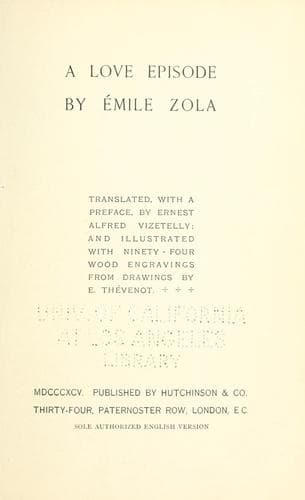
France -- Social life and customs -- 19th century -- Fiction; Women -- Psychology -- Fiction
All alone, all alone. Over the bed hung her mother’s dressing-gown,
flung there at random, the skirt bulging out and a sleeve lying across
the bolster, so that the garment looked like some person who had fallen
down overwhelmed with grief, and sobbing in misery. There was some
linen scattered about, and a black neckerchief lay on the floor like a
blot of mourning. The chairs were in disorder, the table had been
pushed in front of the wardrobe, and amidst it all she was quite alone.
She felt her tears choking her as she looked at the dressing-gown which
no longer garmented her mother, but was stretched there with the
ghastly semblance of death. She clasped her hands, and for the last
time wailed, “Mamma! mamma!” The blue velvet hangings, however,
deadened the sound. It was all over, and she was alone.
Then the time slipped away. The clock struck three. A dismal, dingy
light came in through the windows. Dark clouds were sailing over the
sky, which made it still gloomier. Through the panes of glass, which
were covered with moisture, Paris could only be dimly seen; the watery
vapor blurred it; its far-away outskirts seemed hidden by thick smoke.
Thus the city even was no longer there to keep the child company, as on
bright afternoons, when, on leaning out a little, it seemed to her as
though she could touch each district with her hand.
What was she to do? Her little arms tightened in despair against her
bosom. This desertion seemed to her mournful, passing all bounds,
characterized by an injustice and wickedness that enraged her. She had
never known anything so hateful; it struck her that everything was
going to vanish; nothing of the old life would ever come back again.
Then she caught sight of her doll seated near her on a chair, with its
back against a cushion, and its legs stretched out, its eyes staring at
her as though it were a human being. It was not her mechanical doll,
but a large one with a pasteboard head, curly hair, and eyes of enamel,
whose fixed look sometimes frightened her. What with two years’
constant dressing and undressing, the paint had got rubbed off the chin
and cheeks, and the limbs, of pink leather stuffed with sawdust, had
become limp and wrinkled like old linen. The doll was just now in its
night attire, arrayed only in a bed-gown, with its arms twisted, one in
the air and the other hanging downwards. When Jeanne realized that
there was still some one with her, she felt for an instant less
unhappy. She took the doll in her arms and embraced it ardently, while
its head swung back, for its neck was broken. Then she chattered away
to it, telling it that it was Jeanne’s best-behaved friend, that it had
a good heart, for it never went out and left Jeanne alone. It was, said
she, her treasure, her kitten, her dear little pet. Trembling with
agitation, striving to prevent herself from weeping again, she covered
it all over with kisses.
Public-domain text, read in full here on John Shaqi.
Reviews
Reviews
No reviews yet
Be the first to share your thoughts on this work.
Elsewhere in the archive
Join the Discussion
Join the discussion
Sign in to leave a comment or review.
Sign InorCreate an account