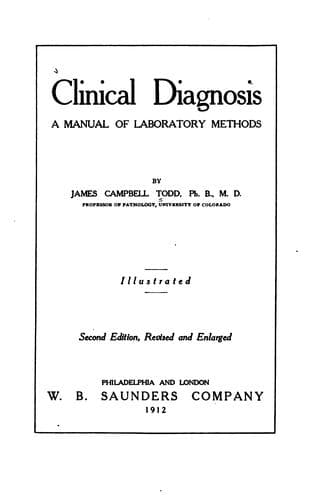
A Manual of Clinical DiagnosisTodd, James Campbell
Science
A Manual of Clinical Diagnosis
Todd, James Campbell
Diagnosis, Laboratory
The more conspicuous characteristics of the blood in various diseases
have been mentioned in previous sections. Although the great majority
of blood changes are secondary, there are a few blood conditions in
which the changes are so prominent, or the etiology so obscure, that
they are commonly regarded as blood diseases. These will receive brief
consideration here.
A. ANEMIA
This is a deficiency of hemoglobin, or red corpuscles, or both. It is
either primary or secondary. The distinction is based chiefly upon
etiology, although each type presents a more or less distinctive
blood-picture. Secondary anemia is that which is symptomatic of some
other {204} pathologic condition. Primary anemia is that which
progresses without apparent cause.
1. Secondary Anemia.--The more important conditions which produce
secondary or symptomatic anemia are:
(_a_) _Poor nutrition_, which usually accompanies unsanitary
conditions, poor and insufficient food, etc.
(_b_) _Acute infectious diseases_, especially rheumatism and typhoid
fever. The anemia is more conspicuous during convalescence.
(_c_) _Chronic infectious diseases_: tuberculosis, malaria, syphilis,
leprosy.
(_d_) _Chronic exhausting diseases_, as heart disease, chronic
nephritis, cirrhosis of the liver, and gastro-intestinal diseases,
especially when associated with atrophy of gastric and duodenal
glands. The last may give an extreme anemia, indistinguishable from
pernicious anemia.
(_e_) _Chronic poisoning_, as from lead, arsenic, and phosphorus.
(_f_) _Hemorrhage_--either repeated small hemorrhages, as from gastric
cancer and ulcer, uterine fibroids, etc., or a single large one.
(_g_) _Malignant tumors_: these affect the blood partly through
repeated small hemorrhages, partly through toxic products, and partly
through interference with nutrition.
(_h_) _Animal Parasites_.--Some cause no appreciable change in the
blood; others, like the _Uncinaria_ and _Bothriocephalus latus_, may
produce a very severe anemia, almost identical with pernicious anemia.
Anemia in these cases is probably due both to toxins and to
abstraction of blood.
The blood-picture varies with the grade of anemia. {205} Diminution of
hemoglobin is the most characteristic feature. In mild cases it is
slight, and is the only blood change to be noted. In very severe cases
hemoglobin may fall to 15 per cent. Red corpuscles are diminished in
all but very mild cases, while in the severest cases the red corpuscle
count is sometimes below 2,000,000. The color index is usually
decreased.
Although the number of leukocytes bears no relation to the anemia,
leukocytosis is common, being due to the same cause.
Public-domain text, read in full here on John Shaqi.
Reviews
Reviews
No reviews yet
Be the first to share your thoughts on this work.
Elsewhere in the archive
Join the Discussion
Join the discussion
Sign in to leave a comment or review.
Sign InorCreate an account