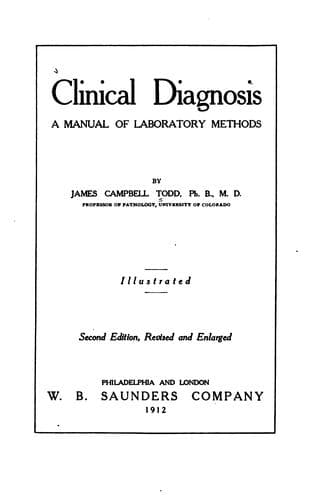
A Manual of Clinical DiagnosisTodd, James Campbell
Science
A Manual of Clinical Diagnosis
Todd, James Campbell
Diagnosis, Laboratory
proportions | relatively, | apt to be | numbers of | exceed 90
or increase | sometimes | relatively | myelocytes | per cent.
of | absolutely, | increased. | (average, 20| Other
polynuclears.| increased. | | per cent.). | varieties
| | | Absolute | relatively
| | | increase of | decreased.
| | | eosinophiles|
| | | and |
| | | basophiles. |
| | | Relative |
| | | decrease of |
| | | polynuclears|
| | | and |
| | | lymphocytes.|
-------------+-------------+-------------+-------------+------------
{213}
CHAPTER IV
THE STOMACH
Laboratory methods may be applied to the diagnosis of stomach
disorders in: I. Examination of the gastric contents removed with the
stomach-tube. II. Certain other examinations which give information as
to the condition of the stomach.
I. EXAMINATION OF THE GASTRIC CONTENTS
Stomach digestion consists mainly in the action of pepsin upon
proteids in the presence of hydrochloric acid and in the curdling of
milk by rennin.
Pepsin and rennin are secreted by the gastric glands as
zymogens--pepsinogen and renninogen, respectively--which are converted
into pepsin and rennin by hydrochloric acid. Hydrochloric acid is
secreted by certain cells of the fundus glands. It at once combines
loosely with the proteids of the food, forming acid-albumin, the first
step in proteid digestion. Hydrochloric acid, which is thus loosely
combined with proteids, is called "combined" hydrochloric acid. The
acid which is secreted after the proteids present have all been
converted into acid-albumin remains as "free" hydrochloric acid, and,
together with pepsin, continues the process of digestion.
At the height of digestion the stomach-contents consist essentially
of: (1) Water; (2) free hydrochloric acid; (3) combined hydrochloric
acid; (4) pepsin; (5) rennin; {214} (6) mineral salts, chiefly acid
phosphates, of no clinical importance; (7) particles of undigested and
partly digested food; (8) various products of digestion in solution.
In pathologic conditions there may be present, in addition, various
microscopic structures and certain organic acids, of which lactic acid
is most important.
* * * * *
A routine examination is conveniently carried out in the following
order:
(1) Give the patient a test-meal upon an empty stomach, washing the
stomach previously if necessary.
(2) At the height of digestion, usually in one hour, remove the
contents of the stomach with a stomach-tube.
(3) Measure and examine macroscopically.
Public-domain text, read in full here on John Shaqi.
Reviews
Reviews
No reviews yet
Be the first to share your thoughts on this work.
Elsewhere in the archive
Join the Discussion
Join the discussion
Sign in to leave a comment or review.
Sign InorCreate an account