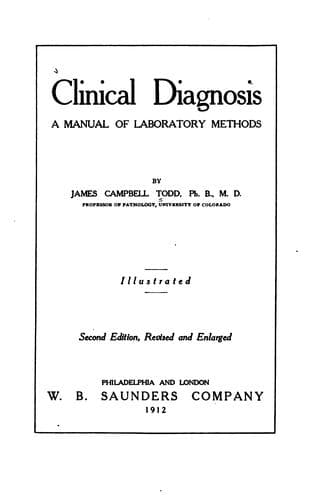
A Manual of Clinical DiagnosisTodd, James Campbell
Science
A Manual of Clinical Diagnosis
Todd, James Campbell
Diagnosis, Laboratory
* * * * *
(5) Rennin and Renninogen.--Rennin is the milk-curdling ferment of the
gastric juice. It is derived from renninogen through the action of
hydrochloric acid. Lime salts also possess the power of transforming
renninogen into the active ferment.
Deficiency of rennin has the same significance as deficiency of
pepsin, and is more easily recognized. Since the two enzyms are almost
invariably present or absent together, the test for rennin serves also
as a test for pepsin.
* * * * *
Test for Rennin.--Neutralize 5 c.c. filtered gastric juice with very
dilute sodium hydroxid solution; add 5 c.c. fresh milk, and place in
an incubator or in a vessel of water at about 104° F. Coagulation of
the milk in ten to fifteen minutes shows a normal amount of rennin.
Delayed coagulation denotes a less amount.
{223} Test for Renninogen.--To 5 c.c. neutralized gastric juice add
2 c.c. of 1 per cent. calcium chlorid solution and 5 c.c. fresh milk,
and place in an incubator. If coagulation occurs, renninogen is
present.
* * * * *
(6) Blood.--Blood is present in the vomitus in a great variety of
conditions. When found in the fluid removed after a test-meal, it
commonly points toward ulcer or carcinoma. Blood can be detected in
nearly one-half of the cases of gastric cancer. The presence of
swallowed blood must be excluded.
* * * * *
Test for Blood in Stomach-contents.--To 10 c.c. of the fluid add a few
cubic centimeters of glacial acetic acid and shake the mixture
thoroughly with an equal volume of ether. Separate the ether and apply
to it the guaiac test (p. 89); or evaporate and apply the hemin test
(p. 202) to the residue. When brown particles are present in the
fluid, the hemin test should be applied directly to them.
* * * * *
2. Quantitative Tests.--(1) Total Acidity.--The acid-reacting
substances which contribute to the total acidity are free hydrochloric
acid, combined hydrochloric acid, acid salts, mostly phosphates, and,
in some pathologic conditions, the organic acids. The total acidity is
normally about 50 to 75 _degrees_ (see method below), or, when
estimated as hydrochloric acid, about 0.2 to 0.3 _per cent._
* * * * *
Public-domain text, read in full here on John Shaqi.
Reviews
Reviews
No reviews yet
Be the first to share your thoughts on this work.
Elsewhere in the archive
Join the Discussion
Join the discussion
Sign in to leave a comment or review.
Sign InorCreate an account