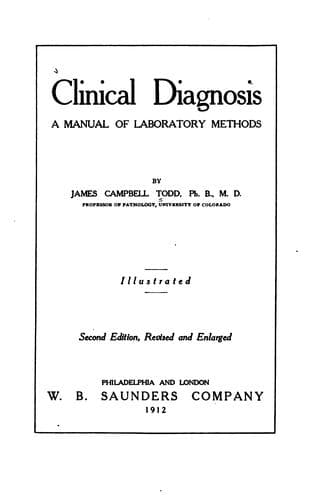
A Manual of Clinical DiagnosisTodd, James Campbell
Science
A Manual of Clinical Diagnosis
Todd, James Campbell
Diagnosis, Laboratory
_Diluting Fluids_.--The diluting fluid should dissolve the red
corpuscles so that they will not obscure the leukocytes. The simplest
fluid is a 0.5 per cent. solution of acetic acid. More satisfactory is
the following: glacial acetic acid, 1 c.c.; 1 per cent. aqueous
solution of gentian-violet, 1 c.c.; distilled water, 100 c.c. These
solutions must be filtered frequently.
* * * * *
V. ENUMERATION OF BLOOD-PLAQUES
The average normal number of plaques is variously given as 200,000 to
700,000 per c.mm. of blood. The latter figure probably more nearly
represents the true normal average, since the lower counts were
obtained for the most part by workers who used unreliable methods.
Physiologic variations are marked; thus, the number {166} increases as
one ascends to a higher altitude, and is higher in winter than in
summer. There are unexplained variations from day to day; hence a
single abnormal count should not be taken to indicate a pathologic
condition.
Pathologic variations are often very great. Owing to lack of knowledge
as to the origin of the platelets and to the earlier imperfect methods
of counting, the clinical significance of these variations is
uncertain. The following facts seem, however, to be established:
(_a_) In acute infectious diseases the number is subnormal or normal.
If the fever ends by crisis, the crisis is accompanied by a rapid and
striking increase.
(_b_) In secondary anemia plaques are generally increased, although
sometimes decreased. In pernicious anemia they are always greatly
diminished, and an increase should exclude the diagnosis of this
disease.
(_c_) They are decreased in chronic lymphatic leukemia, and greatly
increased in the myelogenous form.
(_d_) In purpura hæmorrhagica the number is enormously diminished.
Blood-plaques are difficult to count owing to the rapidity with which
they disintegrate and to their great tendency to adhere to any foreign
body and to each other. The method of Kemp, Calhoun, and Harris is
practical and is to be recommended:
* * * * *
Public-domain text, read in full here on John Shaqi.
Reviews
Reviews
No reviews yet
Be the first to share your thoughts on this work.
Elsewhere in the archive
Join the Discussion
Join the discussion
Sign in to leave a comment or review.
Sign InorCreate an account