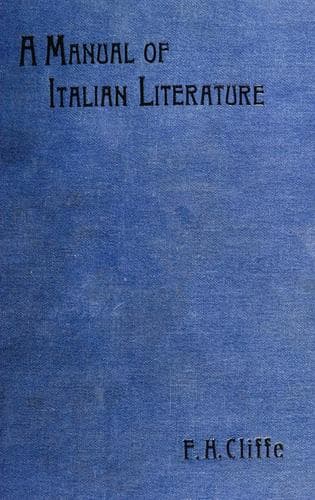
A manual of Italian literatureCliffe, Francis Henry
History
A manual of Italian literature
Cliffe, Francis Henry
Italian literature -- History and criticism
Mr. Charles Edwardes has translated with great skill Leopardi's Prose
Works; I have translated his Poems, so that readers who may not be
acquainted with Italian, can now obtain an idea of his philosophy and
of his poetry. Equally as a thinker and as a poet, he is distinguished
by depth. As a Prose writer, he bears a striking resemblance to Pascal.
In both there is the same gloomy power of imagination, the same method
of profound meditation, and the same intensity of pessimism. As a poet
he displays the most marvellous variety of thought and of expression.
His mock-heroic poem, entitled _Paralipomeni della Batracomiomachia,_
is, as the name indicates, a sort of continuation of the Greek Poem
describing the War of the Frogs and the Rats. The subject is wretchedly
chosen and it is obvious that the narrative serves only to introduce
the digressions, and it is in these digressions that the poet's
brilliant imagination and felicity of style are displayed. Indeed,
in the style alone can the work be said to have any merit. It is the
longest of his poetical productions, and it is greatly to be regretted
that he did not bestow the labour wasted on so frivolous a subject
upon a theme worthier of his genius. Still, there are some fine
passages, as, for instance, a most poetical description of Night, of
which I subjoin a translation:
"The star of Venus in the Heavens high
Appeared before the other stars or moon;
Silent was all; no breath was heard, no cry,
Unless the murmur of a far lagoon,
And buzzing gnats who from the forest fly
When veiling shades replace the glare of noon;
The lovely face of Hesperus serene
Was in the lake in pure reflection seen.
The poem also offers an exquisite description of the Cuckoo, which may
be compared to Wordsworth's poem on the same subject:
In fragrant May, when love and life are bound
In closer links, we hear the Cuckoo far,
Mysterious bird, who in the woods profound
Gives vent to sighs that almost human are,
Who, like a ghost nocturnal, all around
Deludes the shepherd following from afar;
Nor long is heard the voice: it wanes and dies,
Though born in Spring, when Summer heats arise."
But Leopardi's universal renown is founded upon the forty-one poems and
fragments of poems published under the collective title of _Canti._
Thirty-four of the pieces are complete and original poems, seven are
either fragments or translations.
Public-domain text, read in full here on John Shaqi.
Reviews
Reviews
No reviews yet
Be the first to share your thoughts on this work.
Elsewhere in the archive
Join the Discussion
Join the discussion
Sign in to leave a comment or review.
Sign InorCreate an account