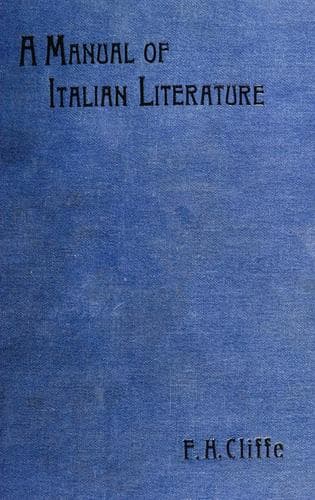
A manual of Italian literatureCliffe, Francis Henry
History
A manual of Italian literature
Cliffe, Francis Henry
Italian literature -- History and criticism
Another satirist of merit was BENEDETTO MENZINI. Like Filicaia, he
enjoyed the patronage of Christina of Sweden. Never, since the terrible
catastrophe of the sack of Rome under Clement VII, did the Eternal
City present such a magnificent aspect as in the latter part of the
Seventeenth Century. The stately days of Leo X seemed to be revived.
Alexander VII signalised his Pontificate by extraordinary splendour.
The colonnade enclosing the square before St. Peter's was erected by
Bernini in his reign. Christina vied with the Pope in the magnificence
of her Court. The Ambassadors to the Vatican endeavoured to out-shine
each other in pomp and luxury. If Menzini who lived in the heart of
this splendid society, did not transfer more than a dim reflection of
its brilliancy to his pages, he writes at least as a man who has seen
and observed much, and he is neither a pedant nor an empty declaimer.
He wrote an Art of Poetry--in verse, almost as good as that written in
France at the same period by Boileau. His sonnets and serious poems are
much more conventional. He was a good Latinist, but the great series of
Italian writers of Latin poems closed with the sparkling epigrams of
the brothers Amaltei.
Another lyric poet attracted to Rome by the liberality of the Queen
of Sweden was ALESSANDRO GUIDI. He found a patron not only in that
Princess, but also, early in the Eighteenth Century, in Pope Clement
XI, whose Latin homilies he turned into Italian verse. Previous writers
had, in the composition of their Odes, observed the most rigid rules
of metre and rhyme. The same stanza, the same order of rhymes, was
maintained throughout each poem. Guidi, whether from want of skill, or
from indolence, or from love of originality, was thé first to discard
this iron regularity, and to write Odes in irregular stanzas, even
occasionally leaving verses without giving them a succeeding rhyme.
This was followed at intervals by other writers, until it culminated
in the boundless freedom of Leopardi, who, in his last productions,
introduces rhymes so sparingly as to make his metre little more than
a modification of blank verse. After Leopardi's imitators had tired
the public ear with their slipshod effusions, a reaction set in,
and regular stanzas are now more than ever in favour, the long and
elaborate stanzas of Filicaia being, however, neglected for the lighter
and more pointed quatrains.
By this license, strongly censured at the time, Guidi undoubtedly
gained greater freedom of movement, and he is never obliged to force
his thoughts and twist his phrases. But it cannot be said that his
conceptions are more natural and unconventional than those of his
predecessors. He has no great glow of imagination, no rainbow hues
of fancy, no depth of thought, nor has he any powers of pathos or
tenderness. But he is always tasteful and scholarly, and his works are
perfectly free from any taint of coarseness or vulgarity.
Public-domain text, read in full here on John Shaqi.
Reviews
Reviews
No reviews yet
Be the first to share your thoughts on this work.
Elsewhere in the archive
Join the Discussion
Join the discussion
Sign in to leave a comment or review.
Sign InorCreate an account