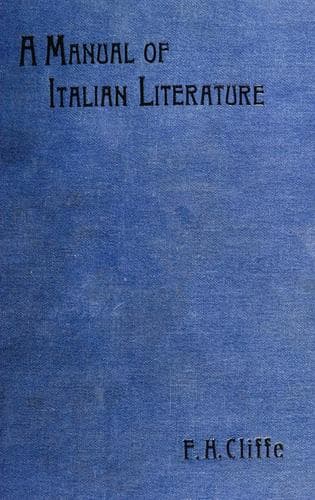
A manual of Italian literatureCliffe, Francis Henry
History
A manual of Italian literature
Cliffe, Francis Henry
Italian literature -- History and criticism
ALESSANDRO MARCHETTI was remarkable rather for his magnificent
translation of Lucretius than for any of his original productions. The
book was considered in Italy of a tendency too dangerous to be allowed
to pass the censorship, and it had to be printed in London and smuggled
surreptitiously into the country of its origin.
FRANCESCO REDI wrote one very celebrated work, _Bacco in Toscana,_ a
dithyramb, full of fire and enthusiasm, a species of poem of which
there are few examples in the Italian language. He was a physician by
profession, and greatly advanced the science of his time. He died in
1698.
CARLO MARIA MAGGI wrote some pleasing poems in the Milanese dialect,
and some of his Sonnets addressed to Italy have the patriotic fire so
much extolled in Filicaia.
FELICE ZAPPI and FAUSTINA MARATTI, his wife, wrote some noble and
spirited Sonnets. One by Zappi on the Moses of Michael Angelo, has most
striking beauty and originality.
The Seventeenth Century was not rich in comic poets. The versifiers of
the age are mostly distinguished by a rather monotonous seriousness.
Two poets, however, are remarkable for their comic inventions, LORENZO
LIPPI and ALESSANDRO TASSONI.
The former, a Florentine, was painter as well as poet. He wrote a
burlesque poem in Ottava Rima called the _Malmantile._ It is valued
as a storehouse of Tuscan phrase, and is, indeed, so full of the slang
of the Mercato Vecchio as to be almost unintelligible to Italians
themselves, much more to foreigners, without the copious annotations of
the commentators.
ALESSANDRO TASSONI was a native of Modena, born in 1565, died in
1635. He distinguished himself as a Commentator on Petrarch, but more
especially by his mock-heroic poem, _La Secchia Rapita,_ which may be
translated _The Rape of the Bucket._ Like so many other writers of
the day, he passed his life in the service of Cardinals md Princes,
and he suffered much from the caprice of his masters and the envy
of his rivals. But he ended his days peacefully as a pensioner of
Francis I, Duke of Modena. His principal work, _La Secchia Rapita,_ has
much ingenuity of thought to recommend it, but his style is somewhat
deficient in colour, and his subject is not very interesting in itself,
nor is it made so by its author. Misled by the similarity of the names,
Dickens, in his _Pictures from Italy,_ attributes the _Secchia Rapita_
to Tasso. Among mock-heroic poems of modern times, Boileau's _Lutrin_
may be said to be slightly inferior to the _Secchia Rapita,_ but Pope's
_Rape of the Lock_ and Leopardi's _Paralipomeni_ vastly superior, both
in brilliancy of thought and perfection of style.
Public-domain text, read in full here on John Shaqi.
Reviews
Reviews
No reviews yet
Be the first to share your thoughts on this work.
Elsewhere in the archive
Join the Discussion
Join the discussion
Sign in to leave a comment or review.
Sign InorCreate an account