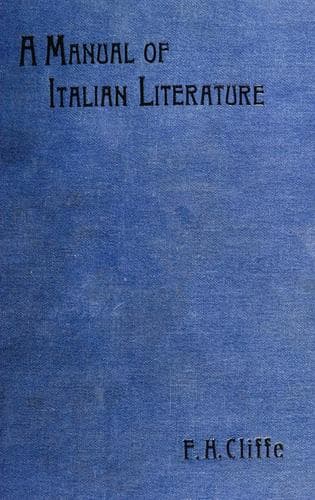
A manual of Italian literatureCliffe, Francis Henry
History
A manual of Italian literature
Cliffe, Francis Henry
Italian literature -- History and criticism
In comparing the poetry of the Seventeenth Century with that of the
Sixteenth, we are struck by the curious fact that its authors have
a more old-fashioned air than their predecessors. This is partly to
be-accounted for by their search for ingenious conceits, which prevents
them from being as flowing and natural as the contemporaries of Ariosto
and Tasso. Their style, too, is more cumbrous. They are fonder of
long and complicated periods than the poets of the Sixteenth Century.
But they have many compensating qualities. Their very fault of being
too artificial in thought and imagery argues the possession of no
little imagination and fertility. A man cannot pervert into strange
and fantastic forms his thoughts and conceptions without being at
considerable pains to do so. None of these writers spare themselves
any trouble, and they often choose the most difficult metres which
the language can present. Their great defect is conventionality of
phraseology, which began with Tasso and only ended in the Nineteenth
Century with Monti. They bedeck themselves with the rags of Ancient
Mythology, and do not seem for a moment to suspect that they would
look much better in unborrowed garments. Instead of talking of the
wind, they talk of Boreas. Instead of mentioning the sea, they mention
Neptune and Thetis. All this makes even the best of them unnatural and
pedantic to a degree, and it is only in their very finest passages that
they are enjoyable to the modern reader. The intense love for Classical
Antiquity had died out with the Renaissance, and the allusions to the
Gods of Greece and Rome were but the outcome of habit and convention.
Instead of adorning their works, these allusions positively make them
dry, for it is only Marino who uses them as they should be used: for
the display of brilliant pageants of description and imagery. He
conjures up a fairyland of his own as Keats did two hundred years later.
[Footnote 1: Lord Somers was a great admirer of Filicaia. See Lord
Campbell's _Lives of the Chancellors,_ and Macaulay's _History._]
CHAPTER XI.
GALILEO AND THE PROSE WRITERS OF THE SEVENTEENTH CENTURY.
In enumerating the Prose Writers of the Seventeenth Century, we are
confronted with the illustrious name of GALILEO GALILEI, which will
continue to be remembered as long as Science is cultivated.
Public-domain text, read in full here on John Shaqi.
Reviews
Reviews
No reviews yet
Be the first to share your thoughts on this work.
Elsewhere in the archive
Join the Discussion
Join the discussion
Sign in to leave a comment or review.
Sign InorCreate an account