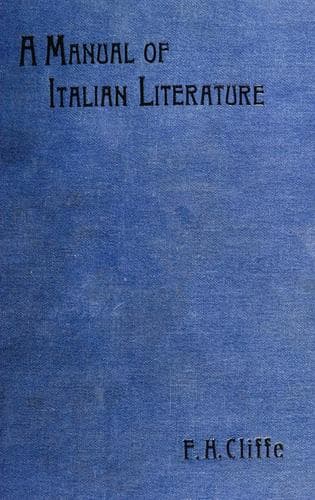
A manual of Italian literatureCliffe, Francis Henry
History
A manual of Italian literature
Cliffe, Francis Henry
Italian literature -- History and criticism
Nor was it only as a man of science that he claimed the admiration of
the world. As a writer, he stands foremost in his age. His prose is
clear, unaffected, graceful, and occasionally eloquent and impressive.
His scientific treatises are models of lucidity. He himself, when
praised for that quality, attributed it in a large measure to his
constant perusal of the works of Ariosto. Clearness, indeed, is the
especial merit of that great poet. In his youth he wrote an essay
to prove the superiority of Ariosto to Tasso. He said Tasso gave us
words, and Ariosto, realities. This assertion may be somewhat sweeping,
but it has a foundation of truth. Still, he admitted that Tasso had
many qualities that please the reader, and that it was only the sharp
scrutiny of criticism which he could not sustain.
The works of Galileo are not very voluminous. First and foremost
in importance, comes the _Dialogue on the Two Systems of Ptolemy
and Copernicus._ His _Saggiatore_ is hardly less important. His
_Problems_ contain descriptions of many experiments, and his Letters
are as remarkable for wit and vivacity as for strength and boldness
of thought. His Essay on the comparative merits of Ariosto and Tasso
has already been mentioned. He took great delight in poetry, and we
are assured by his biographers that he knew by heart many passages
from Virgil, Ovid, Horace, and the Tragedies attributed to Seneca. In
Italian, he derived the greatest pleasure from Ariosto, and next to
him, from Petrarch and Berni. Dante is not mentioned, but it would be
extraordinary if the most profound and graphic of all poets did not
appeal to him, although the vagaries of taste are incalculable. It must
be remembered that in the Seventeenth Century the appreciation of Dante
had sunk to its lowest ebb.
Among those who signed the decree condemning the errors of the
illustrious Galileo, was Cardinal GUIDO BENTIVOGLIO, who, in spite
of that unfortunate circumstance, deserves honourable mention as an
historian and writer of Memoirs. He was employed as Nuncio by several
Popes in Flanders and in France. Gregory XV raised him to the Roman
purple, and when the Conclave met in 1644, after the death of Urban
VIII, there is every reason to believe that he would have been elected
Pope, had he not fallen ill and died on the seventeenth of September.
There is a magnificent portrait of him by Vandyke at Bologna.
Public-domain text, read in full here on John Shaqi.
Reviews
Reviews
No reviews yet
Be the first to share your thoughts on this work.
Elsewhere in the archive
Join the Discussion
Join the discussion
Sign in to leave a comment or review.
Sign InorCreate an account