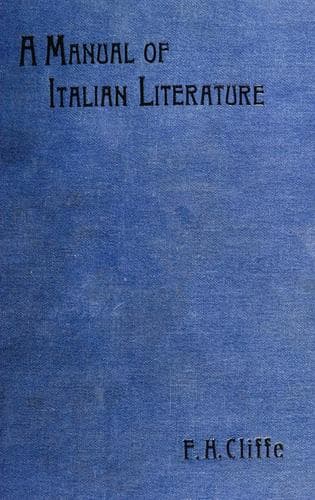
A manual of Italian literatureCliffe, Francis Henry
History
A manual of Italian literature
Cliffe, Francis Henry
Italian literature -- History and criticism
He had many qualities of an able, though not of a great, writer. He had
the advantage of seeing and observing much, and the impress of his
experience is discernible in all he wrote. Ranke extols his Memoirs
as giving an attractive picture of his age, and, in truth, he is one
of the few authors, not of French nationality, who approach in merit
the great memoir-writers of France. He also wrote an account of his
missions as Nuncio, numerous Letters, and a History of the War of
Independence of the Netherlands against the despotism of Spain. The
_History_ is a readable and spirited narrative, and the historian is
seldom prejudiced or bitter. Having himself lived so long in Flanders,
he is able to give graphic descriptions of the localities he mentions.
Ambrosoli censures his style for its monotony, but I cannot say I ever
detected that defect. On the contrary, it seems to me to be as flowing
and animated as can be desired. A writer on historical subjects cannot
be expected to indulge in the fanciful digressions of novelists or
essayists. If Bentivoglio had lived to be Pope, he would doubtless have
distinguished his Pontificate in a manner worthy of his abilities.
A greater historian than Bentivoglio appeared in DAVILA, a native of
Padua. In his youth he served in the French army, and then in that
of the Republic of Venice. He was of noble origin, and his ancestors
occupied the post of Grand Constable of the Island of Cyprus when it
was still under the dominion of Venice. They had the privilege of
taking their seat next to the Doge when they appeared in the Grand
Council, and this privilege was accorded to Davila himself, in such
high esteem was he held. In 1630, he published his _History of the
Civil Wars of France,_ the work to which he is indebted for his
literary fame. He was appointed in the following year Commandant of
the garrison of Crema, but on his way from Venice to that town he was
foully murdered in a village named San Michele.
Davila was a man of action rather than of letters, and it is therefore
not surprising if his style is less purely Tuscan than that of
more elegant scholars. But he had great strength of thought, keen
penetration, and no contemptible knowledge of affairs. These qualities,
added to the interesting events he narrates, secured great attention
and applause for his work. He has, however, some defects. He is not
always very skilful in presenting vivid pictures to the imagination and
he sometimes Italianizes the names of persons and places until they
become hardly recognisable. Thus Elboeuf is metamorphosed into Ellebove.
Public-domain text, read in full here on John Shaqi.
Reviews
Reviews
No reviews yet
Be the first to share your thoughts on this work.
Elsewhere in the archive
Join the Discussion
Join the discussion
Sign in to leave a comment or review.
Sign InorCreate an account