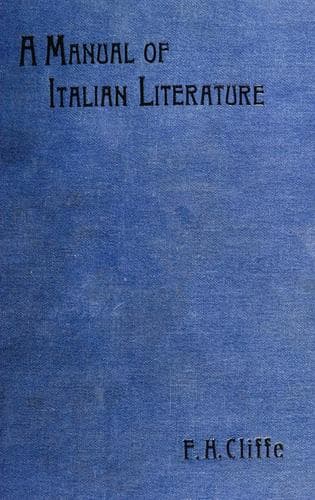
A manual of Italian literatureCliffe, Francis Henry
History
A manual of Italian literature
Cliffe, Francis Henry
Italian literature -- History and criticism
ALFONSO VARANO was a more earnest and impassioned spirit than Frugoni,
and he deserves the credit of having, both by precept and example,
drawn attention to the neglected beauties of Dante. His principal work
is his _Book of Visions,_ written in the metre of Dante and redolent
of his style. Varano resolutely discarded the hackneyed mythological
allusions that disfigure the works of his contemporaries. He is
strictly Christian, and he endeavours to be medieval. But he has hardly
sufficient foundation to go upon, his Visions are about nothing in
particular, and his style is not sufficiently flexible and picturesque
to delight readers who cannot help being reminded of Dante.
The Marquis GIAMBATTISTA SPOLVERINI, of Verona, born in 1695, died
in 1763, is remarkable for one extremely well-written poem in blank
verse on the cultivation of rice. The subject, as may be imagined, had
not previously been treated in poetry, and the author made himself
complete master of the technicalities of his theme. He devoted himself
to the perusal of the great models of poetry, and to writing verses
himself in order to acquire the necessary flexibility of style. He
laboured for many years over the details of the one work by which he
hoped to be remembered, and at last, in the memorable year 1758, he
gave _La Coltivazione del Riso_ to the world. But, alas! the world
paid no heed to the slender volume and went its way as usual. Deep was
the mortification of Spolverini. He could not realise that a poem so
important to himself, should appear so insignificant to the public. His
health and spirits gave way, and he died, unnoticed and unlamented, in
1763. The utter neglect of his contemporaries was neither discerning
nor creditable, and later years did justice to the numerous, though
unobtrusive, beauties of the poem. He has the merit, rare in his age,
of going straight to life and nature, and what he observes he is able
to record in spirited verse. But the subject does not appeal to the
general reader, and hence probably the utter indifference with which it
was received.[1]
GIAMBATTISTA PASTORINI, a native of Genoa, wrote a noble sonnet on the
city of his birth.
TOMMASO CRUDELI wrote some pretty fables. He languished for years in
the dungeons of the Inquisition, and died at the age of forty-two in
1745.
PAOLO ROLLI is remarkable for having translated _Paradise Lost_ into
Italian. He lived for many years as teacher of Italian in London where
he seems to have been well received. He returned to Italy in 1747 and
chose Todi in Umbria as his residence, where he died twenty years later
aged eighty.
Cassiani of Modena, produced some spirited Sonnets; so did ONOFRIO
MINZONI of Ferrara, and PROSPERO MANARA may be mentioned for the same
reason.
PIGNOTTI and BERTOLA were good fabulists, and Bertola enjoyed the
further distinction of being the first to introduce German Literature
into Italy.
Public-domain text, read in full here on John Shaqi.
Reviews
Reviews
No reviews yet
Be the first to share your thoughts on this work.
Elsewhere in the archive
Join the Discussion
Join the discussion
Sign in to leave a comment or review.
Sign InorCreate an account