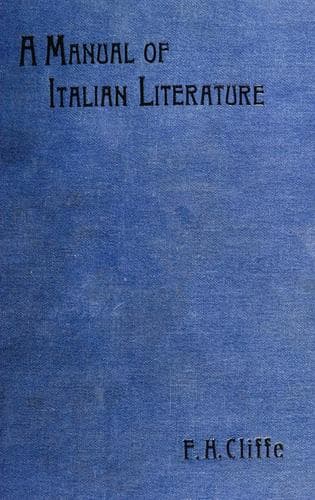
A manual of Italian literatureCliffe, Francis Henry
History
A manual of Italian literature
Cliffe, Francis Henry
Italian literature -- History and criticism
SAVERIO BETTINELLI, a Jesuit, may, perhaps, be taken as the most
perfect embodiment of the Italian literary man of the Eighteenth
Century. He had the light and easy style, the narrow canons of taste
and judgement, and the humane and benevolent spirit that characterised
his contemporaries. Although a Priest, he was a correspondent of
Voltaire, and the Italian Jesuit joined with the French Philosopher in
condemning the extravagant conceptions of those dreadful barbarians,
Dante and Shakespeare. In Dante he could discover absolutely no merit,
and he wrote long essays to convert his countrymen to his views. As
a poet, he is not without fluency and elegance, qualities which are
also conspicuous in his prose, which may still be read with pleasure,
though hardly with profit. His Tragedies appear very poor by the side
of those of Alfieri. He had plenty of learning and some acuteness, and
the tone of his mind is eminently judicious, but he could hardly rise
to the appreciation of conceptions greater than his own, and the shrine
at which he worshipped was that of academic elegance and delicate
refinement. He was inspired with genuine patriotism which led him to
write not only his chief historical work, _Risorgimento d'Italia,_ but
also some of his most spirited poems. His death took place in 1808, at
the great age of ninety.
ANTONIO MAGLIABECCHI was one of the greatest marvels of erudition
that ever lived. He was a goldsmith by trade, but his heart was in
his books, and through the patronage of Michael Ermini, Librarian to
Cardinal Medici, he obtained access to a library extensive enough to
quench even his thirst for knowledge. When his friend Ermini died, he
became his successor as Librarian. All day long he locked himself up
in his house, reading from morning till night, and only after dark did
he open his door, and then only to admit men of taste and learning in
order to indulge in erudite conversation. His habits were almost those
of a hermit. He wore an old coat which served him as an apparel by day
and a blanket by night. A straw-bottomed chair acted as table for his
frugal meals, and another chair, hardly more comfortable, was his bed
in which he sat up at night reading, reading, reading until he fell
asleep from sheer fatigue. The marvel is that such industry, coupled
with such privations, did not undermine his health, but we hear nothing
of injurious results. He was very kind and benevolent in character,
always ready to assist the inquiring with his knowledge and the needy
with his money. He died in 1714. He was a Florentine by birth, and
he left his library to the Grand Duke of Tuscany, and also a sum of
money, the interest of which was to be used for the purpose of making
valuable additions to the volumes already collected. This library is
still open to the public in Florence. Magliabecchi both by precept and
example, gave an impetus to learning and research, but he did not offer
Public-domain text, read in full here on John Shaqi.
Reviews
Reviews
No reviews yet
Be the first to share your thoughts on this work.
Elsewhere in the archive
Join the Discussion
Join the discussion
Sign in to leave a comment or review.
Sign InorCreate an account