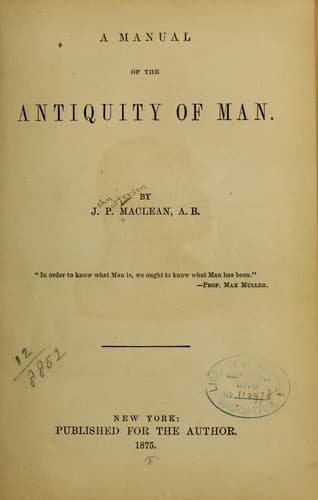
A Manual of the Antiquity of ManMacLean, J. P. (John Patterson)
History
A Manual of the Antiquity of Man
MacLean, J. P. (John Patterson)
Human beings -- Origin
[121] The idea that "bara" meant to create out of nothing is a modern
invention, and most likely called forth by the contact between Jews and
Greeks at Alexandria. The Greeks believed that matter was co-eternal
with the Creator, and it was probably in contradistinction to this
notion that the Jews first asserted that God made all things out of
nothing. The word, however, only calls forth the simple conception of
_fashioning_ or _arranging_.--_Chips_, vol. i. p. 132.
[122] "Testimony of the Rocks," Fifth Lecture.
[123] Rev. Dr. J. P. Thompson represents Adam as a typical man (Man in
Genesis and Geology, p. 105); Lubbock regards him as a typical savage
(Origin Civilization, p. 361). Why not call him the first great
prototype of the human race?
[124] The word _Nod_ means _to wander_, _to be driven about_, etc. It
appears to have been a familiar name at the time of the fratricide. It
was then the name of a land or tract of country. May there not have been
roving tribes there, and from them the place was designated "Wandering
Land"?
[125] Dr. Livingstone, after speaking of a half-caste man on the
Zambesi, described by the Portuguese as a rare monster of humanity,
"remarks, 'It is unaccountable why half-castes, such as he, are so much
more cruel than the Portuguese, but such is undoubtedly the case.' An
inhabitant remarked to Livingstone, 'God made white men, and God made
black men, but the devil made half castes.' When two races, both low in
the scale, are crossed, the progeny seem to be eminently bad. Thus the
noble-hearted Humboldt speaks in strong terms of the bad and savage
disposition of Zambos, or half-castes between Indians and Negroes; and
this conclusion has been arrived at by various observers. From these
facts we may perhaps infer that the degraded state of so many
half-castes is in part due to reversion to a primitive and savage
condition, as well as to the unfavorable moral conditions under which
they generally exist."--_Animals and Plants under Domestication_, vol.
ii. p. 63.
Public-domain text, read in full here on John Shaqi.
Reviews
Reviews
No reviews yet
Be the first to share your thoughts on this work.
Elsewhere in the archive
Join the Discussion
Join the discussion
Sign in to leave a comment or review.
Sign InorCreate an account