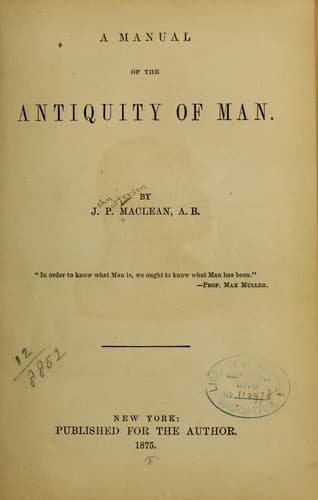
A Manual of the Antiquity of ManMacLean, J. P. (John Patterson)
History
A Manual of the Antiquity of Man
MacLean, J. P. (John Patterson)
Human beings -- Origin
"But, alas! inauspicious days arrive." The roof of their principal cave
falls in, burying their weapons and utensils, and forcing them "to fly
and take up their abode in another spot. The ravages of death break in
upon them.... They bear the corpse into its cavernous sepulchre; some
weapons, an amulet, and perhaps an urn, form the whole of the funeral
furniture. A slab of stone prevents the inroad of wild beasts. Then
begins the funeral banquet, celebrated close by the abode of the dead; a
fire is lighted, great animals are cut up, and portions of their smoking
flesh are distributed to each. How strange the ceremonies that must then
have taken place! ceremonies like those told us of the savages of the
Indian and African solitudes. Imagination may easily depict the songs,
the dances, and the invocations, but science is powerless to call them
into life....
"But the end of this primitive age is at last come. Torrents of water
break in upon the country. Its inhabitants, driven from their abodes, in
vain take refuge on the lofty mountain summits. Death at last overtakes
them, and a dark cavern is the tomb of the wretched beings, who, at
Furfooz, were witnesses of this immense catastrophe."[67]
CHAPTER X.
NEOLITHIC EPOCH.
The Neolithic, or Epoch of Tamed Animals, is characterized by stone
implements, polished or made smooth by a process of grinding and
cutting, the greater development attained in the art of pottery, and by
the presence of the bones of the domesticated animals. This age, in
which no remains of the reindeer occur, immediately follows the reindeer
epoch, and to it are referred in general all discoveries made in the so
called _alluvial_ soil, the most ancient remains of the so called Celts,
the shell-heaps of Denmark, the tumuli or grave-mounds, the dolmens, the
earlier Swiss pile-buildings, the Irish lake-dwellings, and some of the
caves of France.
_Caverns._--The caves belonging to this period, and explored by MM.
Garrigou and Filhol, are those of the Pyrenees and the caves of
Pradiérs, Bedeilhac, Labart, Niaux, Ussat, and Fontanel. Some of these
caverns have been used in earlier ages, as is shown by the remains of
extinct mammals. The upper crust of the floors of the caves belong to
this period, and in them are found the bones of the ox, stag, sheep,
goat, antelope, chamois, wild boar, wolf, dog, fox, badger, hare, and
horse, intermingled with the remains of hearths, also piercers,
spear-heads, and arrow-heads, made of bone; hatchets, knives, scrapers
made of flints, and various other substances, such as silicious schist,
quartzite, leptinite, and serpentine stone. These implements were
carefully wrought, and mostly polished.
Public-domain text, read in full here on John Shaqi.
Reviews
Reviews
No reviews yet
Be the first to share your thoughts on this work.
Elsewhere in the archive
Join the Discussion
Join the discussion
Sign in to leave a comment or review.
Sign InorCreate an account