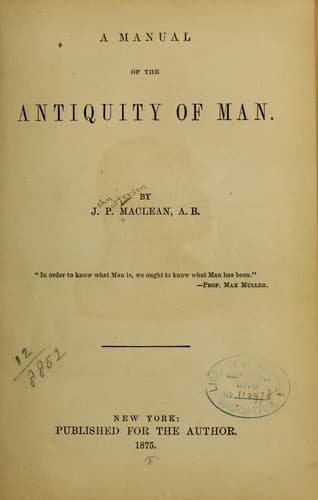
A Manual of the Antiquity of ManMacLean, J. P. (John Patterson)
History
A Manual of the Antiquity of Man
MacLean, J. P. (John Patterson)
Human beings -- Origin
The cave of Saint Jean d'Alcas (Aveyron), explored at different times
by M. Cazalis de Fondace, was used as a place of sepulture. It was first
examined about twenty-five years ago, and at that time five human
skulls, in a good state of preservation, were found, but have been lost,
as their importance was not then known. Intermingled with these bones
were flint, jade, and serpentine implements, carved bones, remains of
rough pottery, stone amulets, and the shells of shell-fish, but no
remains of funeral banquets. At the mouth of the cave were two large
flag-stones lying across one another. The most recent discoveries in the
cave have furnished metallic substances, which would place it, as a
habitation, to the last of the neolithic.
_Danish Kjökken-Möddings, or Shell-Mounds, or kitchen-refuse
heaps._--The refuse heaps of Denmark were carefully examined by
Professors Steenstrup, the naturalist, Forchammer, a geologist, and
Worsaae, the archæologist, commissioned by the Danish government, their
reports being presented to the Academy of Sciences at Copenhagen.
They are found chiefly on the north coast of Denmark, and consist of the
shells of edible mollusks, such as the oyster, cockle, mussel, and
periwinkle. These deposits are from three to ten feet in thickness, from
one hundred to two hundred and fifty feet in width, and sometimes as
much as one thousand feet in length. In them are found weapons and other
instruments of stone, horn, and bone; fragments of rough pottery,
stone-wedges, knives, etc., in great abundance, accompanied with
charcoal and ashes; no traces of coin, bronze, or iron, or domestic
animals, except the dog. The bones of animals are very numerous, but no
human bones have ever been discovered. Professor Steenstrup estimates
that ninety-seven per cent. of the bones belong to the stag, the
roe-deer, and the wild boar. The other remains are those of the urus
(_Bos primigenius_), dog, fox, wolf, marten, wild-cat, hedgehog, bear
(_Ursus arctos_), and the mouse, and the bones of birds and fishes. The
auroch, musk ox, domestic ox, elk, hare, sheep, and domestic hog are
absent.
The mollusca of these shell-mounds are of a size which are never
obtained by the representatives of the same species now living on the
Baltic. They are not more than one-half or even one-third the size. At
the time of the formation of these mounds, the Baltic was a true sea, or
an arm of the ocean, and these mollusks were taken from it. Now the
Baltic has not the character of a true sea, but is merely brackish, and
the oyster does not occur in the Baltic except at its entrance into the
ocean.
These deposits have been found several miles inland, which would
indicate that the sea had once covered the intervening space. On the
western coast they have not been found, in consequence of their having
possibly been swept away by the encroachments of the sea. They are also
found on the adjacent islands.
Public-domain text, read in full here on John Shaqi.
Reviews
Reviews
No reviews yet
Be the first to share your thoughts on this work.
Elsewhere in the archive
Join the Discussion
Join the discussion
Sign in to leave a comment or review.
Sign InorCreate an account