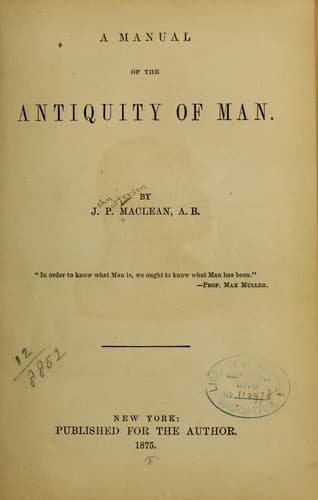
A Manual of the Antiquity of ManMacLean, J. P. (John Patterson)
History
A Manual of the Antiquity of Man
MacLean, J. P. (John Patterson)
Human beings -- Origin
These dwellings were built near the shore, on piles of various kinds of
wood, sharpened by tools and fire, and driven into the mud at the
shallow bottom of the lake. In some of the settlements the piles were
fastened by heaping stones around them. The piles were sometimes placed
together, at others apart. The heads were brought to a level and then
the platform beams were fastened upon them. This basis served for the
foundation of the rude rectangular huts they erected. These piles are
not now seen above the water, yet they are visible above the bottom of
the lake. The number of piles in some of these settlements is as high as
one hundred thousand, and the area occupied, not less than seventy
thousand square yards. It has been estimated that the population of the
Lake-villages during the neolithic was over thirty thousand.
The object of these dwellings was to protect the inhabitants from wild
animals, the attacks of enemies, and for the ready obtaining of food by
fishing. They were not only occupied by the inhabitants, but also by
their herds and the stores of fodder.[69]
_Robenhausen._--It is not necessary to go into an account of a number of
these settlements to represent the neolithic epoch, for the settlement
at Robenhausen (Lake Pfæffikon) takes the first rank in giving the
domestic arrangements of the ancient inhabitants. This settlement
covered a space of nearly three acres, and one hundred thousand piles
were used in the whole structure. Its form was an irregular quadrangle.
It was about two thousand paces from the ancient western shore of the
lake, and about three thousand from the shore in the opposite direction.
With the last-named side there was a communication by means of a bridge,
the piles of which are still visible. On this side were the gardens and
pastures. The dwellers of this settlement were unfortunate, as their
habitation was twice burned up, and each time, they rallied and rebuilt
their huts. They remained a long time as would seem from the depth of
the peat and the vast amount of relics found.
At a depth of eleven feet were found the earliest or most ancient
relics; at ten and one-half feet, the remains of the first
conflagration--charcoal, stone and bone implements, pottery, woven
cloth, corn, apples, etc.; at seven and one-half feet, flooring, relics
of the second settlement, and excrement of cows, sheep, and goats; at
six and one half feet, remains of second conflagration--charcoal, stone
and bone implements, pottery, woven cloth, corn, apples, etc.; at three
and one-half feet, broken stones, flooring, and relics of the third
settlement; at two and one half feet, stone celts, pottery, but no
traces of fire. Above this was two feet of peat and one-half foot of
mould.
Public-domain text, read in full here on John Shaqi.
Reviews
Reviews
No reviews yet
Be the first to share your thoughts on this work.
Elsewhere in the archive
Join the Discussion
Join the discussion
Sign in to leave a comment or review.
Sign InorCreate an account