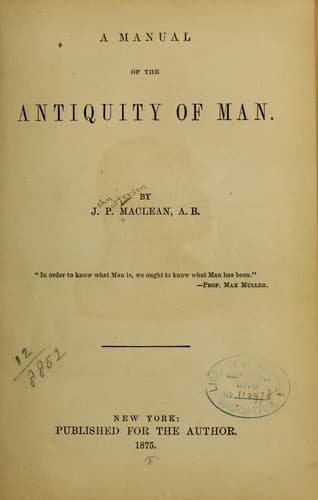
A Manual of the Antiquity of ManMacLean, J. P. (John Patterson)
History
A Manual of the Antiquity of Man
MacLean, J. P. (John Patterson)
Human beings -- Origin
Without going into detail, the objects found in these various beds are
as follows: Made out of wood, are knives, ladles, plates, clubs of ash,
in which is fixed a socket of stag's horn containing a stone celt, a
boat made of a single trunk, twelve feet long, two and one-half feet
wide, and five inches deep, flails for threshing out grain, bows notched
at both ends, fishing implements, floats for the support of nets,
suspension hooks, tubs, chisels, sandals, yokes made for carrying
vessels, and a peculiar ornament. These implements were all made out of
yew, maple, ash, fir, and the root of the hazel bush. Out of stag's
horn--arrow-heads, daggers, piercing and scraping tools, implements for
knitting and for agriculture. The implements of stone were polished, and
of the usual form. The objects of clay were fragments of pottery, in the
shape of urns, plates, and cups, in great abundance. There were also
found spoons, and a perforated cone, supposed to have been used as a
weight for the loom. Several crucibles or melting pots have been found,
which were used for melting copper. The third building of this village
was on the borderland between the stone and bronze ages.
The remains of animals found here and at Moosseedorf and Wauwyl, all of
the neolithic, belong to the brown bear, badger, marten, pine-marten,
polecat, wolf, fox, wild-cat, beaver, elk, urus, bison, stag, roe-deer,
wild-boar, marsh-boar; the domestic animals were the boar, horse, ox,
goat, sheep, and dog. The remains of the domestic hog are absent from
all the pile works of this period, save the one at Wauwyl.
Among cereals (Robenhausen) were found several varieties of wheat and
barley; fruits and berries--service-tree, dog-rose, elder, bilberry, and
wayfaring tree; the nuts--hazel, beech, and water-chestnut; the
oil-producing plants--opium, or garden poppy, and dogwood; the fibrous
plants--flax; plants used for dying--weld; forest trees and
shrubs--silver fir, juniper, yew, ash, and oak; water and marsh
plants--lake scirpus, pondweeds, common hornwort, marsh bedstraw,
buckbean, yellow waterlily, ivy-leaved crowfoot, and marsh pennywort.
Besides these there have been found many specimens of plaited and woven
cloth; also ropes, cords, and a portion of a linseed cake.[70]
In the different settlements the same axes and knives abound, and are of
small size. The arrow-heads and saws are an improvement on those of the
preceding epoch. Among domestic implements, spindle-whorls of rude
earthenware were abundant in some of the villages, and corn-crushers are
occasionally met with from two to three inches in diameter. About five
hundred implements of stone have been found at Wauwyl, consisting of
axes, small flint arrow-heads, flint-flakes, corn-crushers, rude stones
used as hammers, whetstones, and sling-stones.
Public-domain text, read in full here on John Shaqi.
Reviews
Reviews
No reviews yet
Be the first to share your thoughts on this work.
Elsewhere in the archive
Join the Discussion
Join the discussion
Sign in to leave a comment or review.
Sign InorCreate an account