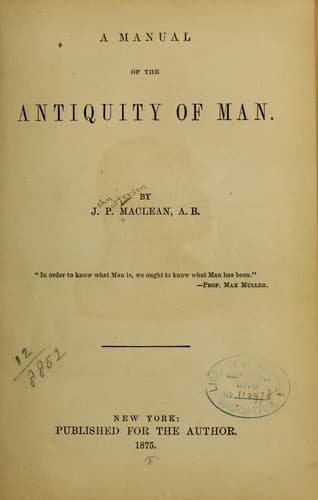
A Manual of the Antiquity of ManMacLean, J. P. (John Patterson)
History
A Manual of the Antiquity of Man
MacLean, J. P. (John Patterson)
Human beings -- Origin
Several attempts have been made to estimate the time which has elapsed
since the neolithic period. The estimates of M. Morlot are based on the
discoveries made in a hillock formed by the river Tinière at its
entrance into the lake of Geneva. This cone contained three distinct
layers of vegetable earth placed at different depths between the
deposits of alluvium. The first was at a depth of three and one-half
feet from the top, and was from four to six inches thick, and in it were
found relics of the Roman period; the second was five and one-fourth
feet lower, and six inches thick, in which were fragments of bronze; the
third was at a depth of eighteen feet from the top, and varied in
thickness from six to seven inches, and contained fragments of the stone
age. History proves that the layer containing the Roman relics is from
thirteen to eighteen centuries old. Since that epoch the cone has
increased three and one-half feet, and if the increase was the same in
previous ages, then the bed containing the bronze is from twenty-nine
hundred to forty-two hundred years old, and the lowest layer, belonging
to the stone age, is from four thousand seven hundred to ten thousand
years old.
The calculation by M. Gillieron was made from the discoveries near the
bridge of Thièle. About one thousand two hundred and thirty feet from
the present shore is the old abbey of Saint Jean, built in the year
1100. There is a document which seems to show that the abbey was built
on the edge of the lake. Then, in seven hundred and fifty years the lake
retired one thousand two hundred and thirty feet. The distance of the
present shore from the settlement of the bridge of Thièle is eleven
thousand and seventy-two feet, and consequently the settlement is not
less than six thousand seven hundred and fifty years old.
M. Figuier assigns to the lake-dwellings an antiquity of from six to
seven thousand years before the Christian era.[74]
CHAPTER XI.
MAN OF THE NEOLITHIC.
From the human bones found in peat-bogs and tumuli, man is represented
as having a narrow but round skull, with a projecting ridge above the
eyebrows, showing he was round-headed, his eyebrows overhanging, small
of stature though stout, and having a great resemblance to the
Laplanders. In many respects the race was much superior to that of the
preceding epoch. Man advanced rapidly in the arts, and made great
progress in civilization. He had passed out of the barbarous, and might
be called a semi-barbarian.
_Habitations._--Man's habitation varied according to the locality. In
the extreme south of France he continued for a considerable length of
time to occupy the caves and rock-shelters; in Switzerland, the
pile-buildings, and in Denmark he undoubtedly had rude huts placed close
together and in proximity to the shell-heaps.
Public-domain text, read in full here on John Shaqi.
Reviews
Reviews
No reviews yet
Be the first to share your thoughts on this work.
Elsewhere in the archive
Join the Discussion
Join the discussion
Sign in to leave a comment or review.
Sign InorCreate an account