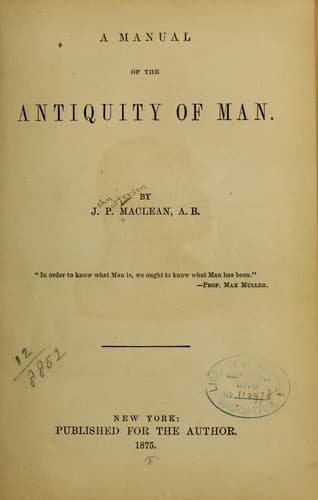
A Manual of the Antiquity of ManMacLean, J. P. (John Patterson)
History
A Manual of the Antiquity of Man
MacLean, J. P. (John Patterson)
Human beings -- Origin
New inventions were brought into use. Among them was a comb which,
according to shape, might be compared to the dung-fork of the American
stables. Ornaments for the body, made of various materials were
fashioned. Pottery was still in a rough state, though gradually
improving. The loom was invented, and various kinds of cloth were
manufactured. Also out of the fibrous plants cordage was made, which
again was fashioned into nets for fishing. Many canoes at various places
have been found, showing that they were not only used for fishing but
also for carrying cargoes. Workshops were established, and there the
stone implements were made and polished; one of these shops was at
Pressigny.
[Illustration: FIG. 16. DANISH AXE-HAMMER, DRILLED FOR HANDLE.]
Some idea may be had of the vast number of stone implements which occur,
when it is considered that in the Museum of Copenhagen there are about
twelve thousand, consisting of flint axes, wedges, broad, narrow, and
hollow chisels; poniards, lance-heads, arrow-heads, flint flakes, and
half-moon-shaped implements. In other collections in Denmark there are
twenty thousand implements. The museum at Stockholm contains about
sixteen thousand, and the Royal Irish Academy owns seven hundred
flint-flakes, five hundred and twelve celts, more than four hundred
arrow-heads, fifty spear-heads, seventy-five scrapers, and numerous
other objects of stone, such as sling-stones, hammers, whetstones,
grain-crushers, etc.[75] Some of these implements, however, may belong
to other epochs.
War must have been carried on to a considerable extent, as fortified
camps have been discovered in Belgium, at Furfooz, and other places.
Their weapons were the axe, the arrow, the spear, and possibly the
knife. These were wrought with great care.
_Agriculture._--Man commenced to till the ground in this age, and thus
laid the true foundation of civilization. He probably was forced to do
it. The beasts of the forest were gradually decreasing. They had
nourished him in the infancy of his mind, and now he should begin to
look to the soil, and by the cultivation of its products he must sustain
his life. His principal implement of agriculture must have been the
sharpened stick, pointed with deer-horn. He cultivated the cereals, made
his corn-mill, and stored the grain for winter use.
Public-domain text, read in full here on John Shaqi.
Reviews
Reviews
No reviews yet
Be the first to share your thoughts on this work.
Elsewhere in the archive
Join the Discussion
Join the discussion
Sign in to leave a comment or review.
Sign InorCreate an account