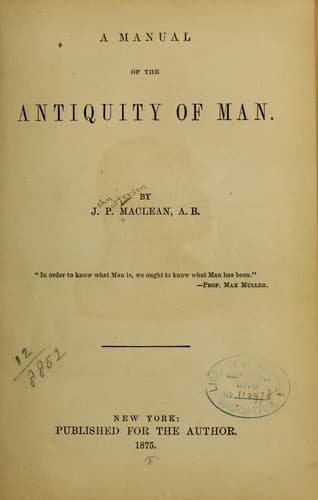
A Manual of the Antiquity of ManMacLean, J. P. (John Patterson)
History
A Manual of the Antiquity of Man
MacLean, J. P. (John Patterson)
Human beings -- Origin
_Fishing and Navigation._--There are no distinct traces of improvement
beyond the past epoch, in fishing and navigation, unless it be in the
improved hooks made of bronze.
_Burial._--The custom of burning the dead was almost universal in
Denmark, and was more or less practised in other countries. The ashes
and fragments of the bone were collected and placed either in or under
an urn. When buried, the corpse was usually placed in a contracted
position, but occasionally extended. With the dead were buried their
implements and clothing. The body of the chief discovered in a tumulus
in Jutland, where the clothing was found, was buried in a coffin nine
and two-third feet long, over two feet in breadth, and covered by a
movable lid. The body was in a good state of preservation, owing to the
action on it of water strongly impregnated with iron. It was wrapped in
the woollen cloak, and again wrapped in an ox's hide. Buried with it
were the shawls, leggings, shirt, boots, and caps, two small boxes, a
bronze razor, comb, a bronze sword in a wooden sheath, and a long
woollen band. In other coffins have been found swords, knives, brooches,
awls, tweezers, and buttons, all of bronze. In a baby's coffin was found
an amber bead, and a small bronze bracelet.
_Religious Belief._--Many crescents, made of stone and earthenware, have
been found which are regarded, by some archæologists, as religious
emblems. Dr. Keller calls them "moon images," and has devoted a short
chapter to their consideration.[77] On the other hand, Lubbock and Carl
Vogt regard them as resting-places for the head at night.[78] They
carefully arranged their long hair, and evidently sacrificed comfort for
vanity. They carried a long pin with which to scratch the head. This
kind of a pillow is still used by the Fuegeans and Abyssinians, who have
their hair elaborately decorated; and in some cases this is never
disturbed. If the people were worshippers the crescent is the only
evidence from archæology. No idols have ever been discovered. That the
people were already worshippers may be learned from the traditions
recorded in history.
CHAPTER XIII.
IRON EPOCH.
As the _Iron Epoch_ fairly establishes civilization, and belongs almost
wholly to the historical epoch, it will be here briefly noticed, and
then dismissed after giving a quotation from Dr. Keller. The bronze had
not only prepared the way for the iron epoch, but also gave a great
impulse to succeeding ages. The art of metallurgy assumed a new
importance and gave new life to every movement that tended to the
assistance of man. The works of bronze gave way to those of iron. A
knife made of iron is represented in Fig. 18. Knives of this pattern
were, however, made of bronze, and served for the same purpose. The
workshops of this age were so numerous that four hundred of them have
been discovered in one province. The potter's wheel was invented; money
was introduced, and agriculture greatly nourished.
Public-domain text, read in full here on John Shaqi.
Reviews
Reviews
No reviews yet
Be the first to share your thoughts on this work.
Elsewhere in the archive
Join the Discussion
Join the discussion
Sign in to leave a comment or review.
Sign InorCreate an account