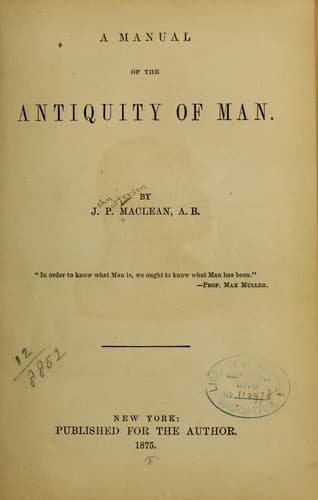
A Manual of the Antiquity of ManMacLean, J. P. (John Patterson)
History
A Manual of the Antiquity of Man
MacLean, J. P. (John Patterson)
Human beings -- Origin
America furnishes a better field for the antiquary than the old world.
Her ancient remains are not so much injured by the decay of empires and
the rude hand of war. Succeeding ages have not so much effaced these
marks, and many of the remains still stand as left by the original
occupants, save only the change and decay which time itself produces.
America will yet be discovered. It is true the landmarks are known; but
these have not been investigated so diligently as the remains of man in
Europe. The Boucher de Perthes and the Dr. Schmerling are yet to come.
Until they do, the history of primitive man in America must be
surrounded with great uncertainty. Much labor has been given to the
investigation of this subject, and many works written, all looking
toward an early development which must sooner or later come.
In this chapter the aim will only be to point out some of these traces.
_Enumeration._--The implements from the gravel beds of Colorado and the
skull from Calaveras county, California, have already been referred to
(pp. 61, 62).
Near Osage Mission, Kansas, there was found a human skull imbedded in a
solid rock, which was broken open by blasting. It was examined by Dr.
Weirley, who compared it with a modern skull, and found it resembled the
latter in general shape, yet it was an inch and a quarter longer. Of
this relic he says: "It belonged to a man of a large size, and was
imbedded in conglomerate rock of the tertiary class, and found several
feet beneath the surface. Parts of the frontal, parietal, and occipital
bones were carried away by the explosion. The piece of rock holding the
remains weighs some forty or fifty pounds, with many impressions of
marine shells, and through it runs a vein of quartz, or within the
cranium crystallized organic matter, and by the aid of a microscope
presents a beautiful appearance." In shape the Neanderthal man comes
nearest to it.[80]
In the Comstock lode (Nevada), at a depth of five hundred feet, Judge A.
W. Baldwin found a human skull of unusual and peculiar shape. It is very
short from base to summit, and exceedingly broad between the ears. The
skull is entire, with the exception of the facial bones. This skull has
never been examined by a competent person.[81]
In the drift-clay, in the city of Toronto, at a depth of two feet from
the surface, were discovered the bones and horn of a deer, amidst an
accumulation of charcoal and ashes, and with them a rude stone chisel or
hatchet.[82]
In the gravel of the gold-bearing quartz of the Grinell leads (Kansas),
was found an imperfect flint knife at a depth of fourteen feet. Above
the implement the gravel, composed of quartz and reddish clay, was ten
feet thick, and above this was four feet of rich black soil. This
implement was given to Dr. Daniel Wilson by Mr. P. A. Scott.[83]
Public-domain text, read in full here on John Shaqi.
Reviews
Reviews
No reviews yet
Be the first to share your thoughts on this work.
Elsewhere in the archive
Join the Discussion
Join the discussion
Sign in to leave a comment or review.
Sign InorCreate an account