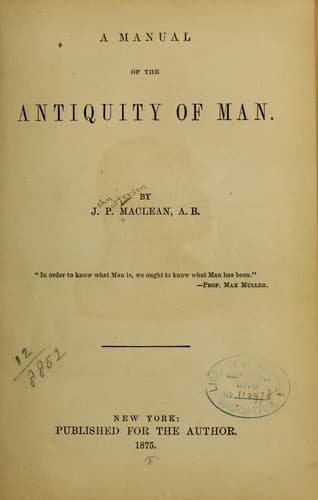
A Manual of the Antiquity of ManMacLean, J. P. (John Patterson)
History
A Manual of the Antiquity of Man
MacLean, J. P. (John Patterson)
Human beings -- Origin
It is not generally known that written history extends so far back as to
make worthless the present system of chronology. The mighty empires of
antiquity must have been a mystery to many a thoughtful mind. As far
back as history will carry us we not only behold the world teeming with
her millions of people, but also nations rising and empires crumbling.
Rollin felt the difficulties of the chronology which hampered him. He
says the Assyrian empire was founded by Nimrod eighteen hundred years
after the creation of man, or two hundred and twenty-four years after
the Deluge, or one hundred and twenty-six years before the death of
Noah. Nimrod was succeeded by his son Ninus, who received powerful
succor from the Arabians, and extended his conquests from Egypt as far
as India and Bactriana. Ninus enlarged his capital to sixty miles in
circumference, built the walls to the height of one hundred feet, and so
broad that three chariots could go abreast upon them with ease, and
fortified and adorned them with one thousand five hundred towers two
hundred feet high. After he had finished this prodigious work he led
against the Bactrians one million seven hundred thousand foot, two
hundred thousand horse, besides four hundred vessels well equipped and
provided. After his death, Semiramis, his wife, ascended the throne. She
enlarged her dominions by the conquest of a great part of Ethiopia. Then
she led her army of three million foot and five hundred thousand horse,
besides the camels and chariots of war, into India, where she suffered a
severe defeat. After making these statements, Rollin says, "I must own
I am somewhat puzzled with a difficulty which may be raised against the
extraordinary things related of Ninus and Semiramis, as they do not seem
to agree with the times so near the Deluge: I mean, such vast armies,
such a numerous cavalry, so many chariots armed with scythes, and such
immense treasures of gold and silver; ... and the magnificence of the
buildings, ascribed to them."[91] The difficulties presented to the
modern historian never would have occurred if discredit had not been
thrown on the writings of the ancients.
Public-domain text, read in full here on John Shaqi.
Reviews
Reviews
No reviews yet
Be the first to share your thoughts on this work.
Elsewhere in the archive
Join the Discussion
Join the discussion
Sign in to leave a comment or review.
Sign InorCreate an account