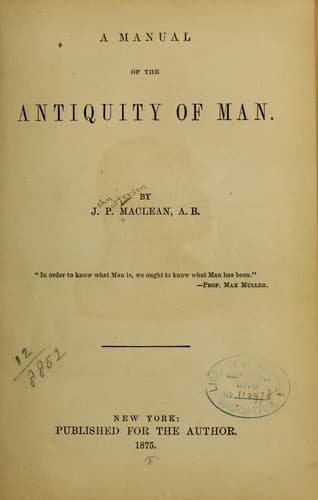
A Manual of the Antiquity of ManMacLean, J. P. (John Patterson)
History
A Manual of the Antiquity of Man
MacLean, J. P. (John Patterson)
Human beings -- Origin
4 and 5. The fourth and fifth amount to the assumption that no race will
amalgamate with another. The statements embraced under these two heads
are not warranted by facts. Dr. Prichard says, "Mankind of all races and
varieties are equally capable of propagating their offspring by
intermarriages, and that such connections are equally prolific whether
contracted between individuals of the same or of the most dissimilar
varieties. If there is any difference, it is probably in favor of the
latter."[119] He then gives a short account of several examples of new
or intermediate stocks which have been produced and multiplied. They are
Griquas, descended from the Dutch and Hottentots, who occupy the banks
of the Orange River, and number five thousand souls; the Cafusos of
Brazil, a mixture of native Americans and African Negroes; the Papuas of
the island of New Guinea, a mixture between the Malays and Negroes. One
of the best examples yet furnished is that of the Pitcairn Islanders.
This colony originated in this way: The British government had sent a
vessel, called the Bounty, commanded by Lieutenant Bligh, to gather
bread-fruit trees at Otaheite and introduce them into the West Indies.
Bligh was an overbearing, tyrannical, and cruel officer. Driven to fury,
and out of patience with the superior officer, Mr. Fletcher Christian
and others mutinied, and turned Bligh and his eighteen companions
adrift. The mutineers proceeded to Tahiti; here they took on board
provisions and live stock, nine Tahitian men, twelve women, and eight
boys who had secreted themselves, and then proceeded to Toubouai, where
they founded a settlement. Owing to dissensions the colony broke up and
removed to Tahiti. But Mr. Christian, with eight other of the mutineers,
three Toubouaians, three Tahitian men with their wives, and one child,
and nine other women, left in the Bounty and landed at Pitcairn's
Island, and there burned the Bounty on the 23d of January, 1790. In less
than nine years afterward, owing to strifes, the men were reduced to two
in number, both whites, and one of them died the succeeding year. In the
year 1808 the American ship Topaz touched at the island. The colonists
then numbered thirty-five. In 1856 they had increased to the number of
one hundred and ninety, and as the produce of the island was barely
sufficient to support them they were removed by the British government
to Norfolk Island. There are only eight surnames among them--five of the
Bounty stock and three new-comers. They are a fine, healthy race of
people; the men of a bright copper color, but the women are scarcely
distinguishable from English women. If reports be true concerning them,
they are the most remarkable people on earth. They never allow the sun
to go down on their wrath, and are noted for their honesty, truth,
chastity, industry, benevolence, reverence, simplicity, and all the
virtues which combine to form true religion.
Public-domain text, read in full here on John Shaqi.
Reviews
Reviews
No reviews yet
Be the first to share your thoughts on this work.
Elsewhere in the archive
Join the Discussion
Join the discussion
Sign in to leave a comment or review.
Sign InorCreate an account