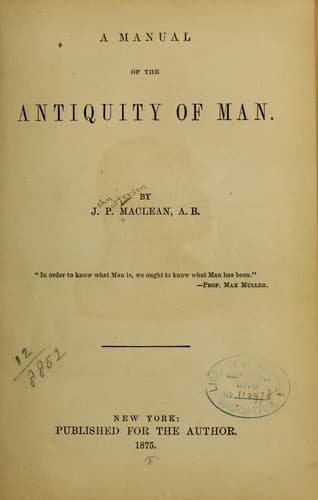
A Manual of the Antiquity of ManMacLean, J. P. (John Patterson)
History
A Manual of the Antiquity of Man
MacLean, J. P. (John Patterson)
Human beings -- Origin
No book has caused so much controversy as the Bible. It has been made to
answer for the folly of both its friends and foes. The fierce assaults
made by the sceptic have been the legitimate result of the preposterous
claims made by its ignorant but too zealous friends. The Bible makes no
such claims for itself as have often been made for it. Its meaning has
been perverted, sentences distorted, and words changed in order to suit
the caprice of its advocates. If it were a living, speaking existence,
it would certainly beg to be delivered from its friends. It has been
made to conflict with the investigations of science, and those engaged
in interpreting the laws of nature have been branded as infidels,
although they may have devout and reverent spirits. The Bible is not and
makes no pretensions of being a book of science. It is designed to be a
book of religion, and a history of the ancient Jews, and its references
to scientific questions are only incidental. If the references to
science, or the account of Creation be radically wrong, its teachings on
questions of morals and religion would not be thereby invalidated. The
Christian, or the Jew, has nothing to fear from the results of
scientific investigation. But there is a duty devolving on him, and that
is to leave his fanciful interpretations and come to the true meaning of
the Scriptures, and there learn how the words were understood by those
to whom they were originally addressed. The meaning of words, as used in
the nineteenth century, is not to be connected with their signification
as used in the past. There is a great distance that divides the present
from the times of the Hebrews, and their language and thoughts from the
English language and modern thought. The ancient Hebrews were not given
to scientific pursuits, and could have been but comparatively little
advanced in civilization.
It is not the design here to enter upon an investigation of the points
raised between the Scriptures and science, but to confine the inquiry to
such questions as the previous chapters have demanded.
_Creation._--The first and second chapters of Genesis not only teach
that God is the Creator of heaven and earth, but also the order of
succession is given. It is not stated that the world was created out of
nothing. The word "bara," translated "created," has a variety of
meanings. According to Gesenius it means _to cut_, _to cut out_, _to
carve_, _to form_, _to create_, _to produce_, _to beget_, _to bring
forth_, _to feed_, _to eat_, _to grow fat_, _to fashion_, _to
make_.[121] The idea presented seems to be this: The author asserts that
heaven and earth owe their origin to God. Then he goes back and explains
the successive stages of creation. At the commencement of the work the
earth was formless and void, or in a nebulous condition, and from this
preëxisting mass the worlds were evolved. When this mass was created, if
ever, the author of Genesis does not state.
Public-domain text, read in full here on John Shaqi.
Reviews
Reviews
No reviews yet
Be the first to share your thoughts on this work.
Elsewhere in the archive
Join the Discussion
Join the discussion
Sign in to leave a comment or review.
Sign InorCreate an account