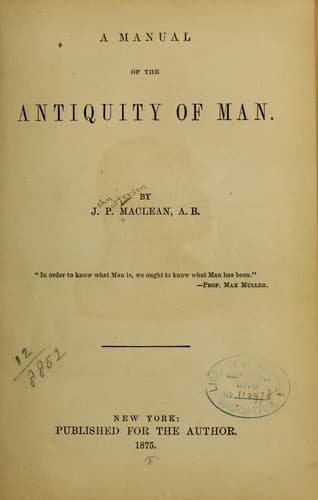
A Manual of the Antiquity of ManMacLean, J. P. (John Patterson)
History
A Manual of the Antiquity of Man
MacLean, J. P. (John Patterson)
Human beings -- Origin
If it was right then, it is right now.
The city he built must have been more than an _encampment_, or a _small
fortification_. (The word translated "city" bears this meaning also.) It
would have been of no moment. It must have been a place of some
consequence, and designed for more persons than Cain, his wife, and son.
Taking all the circumstances together, including Cain's dread "of every
one that findeth me shall slay me," it would seem that the object of
this city was to provide for individuals of the pre-Adamic family
dwelling on the east of Eden, and possibly to ingratiate himself into
their favor.
Then, again, in the sixth chapter, "The sons of God saw the daughters of
men that they were fair; and they took them wives of all which they
chose." This was followed by great wickedness, in consequence of which
the world was destroyed by a flood. Who were the "sons of God," and who
the "daughters of men"? Why not the daughters of God? The "sons of God"
must have been the lineal descendants of Adam, and the "daughters of
men" the offspring of the pre-Adamic race. The mongrel race produced
were monsters,[125] and their minds were bent continually on doing evil.
These sons of Adam must have retrograded, or else they would not have
sought wives from among a lower people. By the laws of nature their
offspring was lower than either of the races, from the fact that to the
brutish natures of the pre-Adamic type would be added the natural wisdom
of the Adamic, thus producing cunning and craft in their
wickedness.[126] If stringent moral laws had been enforced upon them the
result would have been reversed.
_Chronology._--The chronology given in the margins of the Bible is a
mere invention, and has worked much mischief. There is nothing to
warrant it, and no excuse can be made for it. The Bible gives no
definite chronology for those early times. That no dependence can be
placed in these chronologies is shown from the discrepancies between the
Septuagint and the Hebrew texts.[127] The Septuagint dates the Flood
eight hundred years farther back than the common Bible. "A margin of
variation amounting to eight centuries between two versions of the same
document, is a variation so enormous that it seems to cast complete
doubt on the whole system of interpretation on which such computations
of time are based."[128]
Public-domain text, read in full here on John Shaqi.
Reviews
Reviews
No reviews yet
Be the first to share your thoughts on this work.
Elsewhere in the archive
Join the Discussion
Join the discussion
Sign in to leave a comment or review.
Sign InorCreate an account