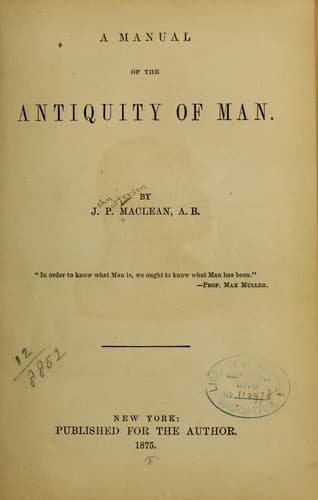
A Manual of the Antiquity of ManMacLean, J. P. (John Patterson)
History
A Manual of the Antiquity of Man
MacLean, J. P. (John Patterson)
Human beings -- Origin
_The Dispersion._--The building of the tower of Babel is no myth, but a
veritable reality. A portion of the mighty fabric still stands, a
mountain of ruins, attesting to the vast amount of work it required in
its construction. The story is told in few words, and those words cover
centuries. The people engaged in its construction spoke one language,
but when this language was confounded the empire was rent asunder. The
narrative seems to teach the use of but one language on the whole face
of the earth. Dr. F. H. Hedge, in his sermon on "the Great Dispersion,"
says, "Moreover, the phrase 'the whole earth,' as commonly used in the
Bible, is not to be taken in an absolute or scientific sense. It is not
intended to include the entire globe, or even the greater part thereof,
but is loosely employed to designate the whole of that particular
portion which the writer or speaker has in his mind at the time. In the
present case it denotes the country bordering on the Tigris and the
Euphrates."[131] If the views of this eminent theologian be correct,
then, by the same principle of interpretation the unity of language
spoken of, is limited to the country bordering on the Tigris and the
Euphrates.
There is no necessity of a supernatural aid for the origination of
language. Under the view already advanced, when the animals were brought
to Adam, he readily gave them names, for he had received language from
his predecessors, and now, being an especially chosen person, his
endowments would lead him to a more vigorous application of its use.
It is not incredible that God could have fashioned the world and peopled
it with myriads of beings in a period of six days of twenty-four hours
each. It is not incredible that a cataclysm could destroy every living
creature, save an appointed few, and cover the remotest boundaries of
the earth. It is possible for God to do anything save that which is
inconsistent with his character. What is possible for God to do, and
what He does, are two very different things. What He has done can only
be told from the evidences which He has left. What He might have done is
only speculation. Man can only judge from the facts presented to him. He
observes the course of nature, and from these observations his
conclusions are drawn.
The world of nature and the spirit of revelation, when properly
understood, are seen to be in harmony. Man is not to close his eyes and
refuse to be guided by science, and with blind credulity accept the
tales and prejudices of his grandfathers.
Public-domain text, read in full here on John Shaqi.
Reviews
Reviews
No reviews yet
Be the first to share your thoughts on this work.
Elsewhere in the archive
Join the Discussion
Join the discussion
Sign in to leave a comment or review.
Sign InorCreate an account