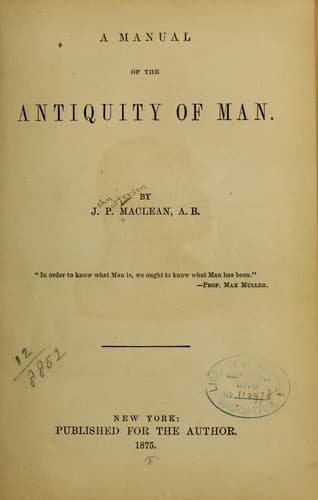
A Manual of the Antiquity of ManMacLean, J. P. (John Patterson)
History
A Manual of the Antiquity of Man
MacLean, J. P. (John Patterson)
Human beings -- Origin
Neolithic, new stone age; a term applied to the more modern age of
stone.
Nummulitic, composed of, or containing a fossil of a flattened form,
resembling a small coin, and common in the early tertiary period.
Obsidian, a kind of glass produced by volcanoes.
Occipital, pertaining to the back part of the head.
Ochreous, consisting of fine clay, containing iron.
Olecranon, the large process at the extremity of the larger bone of
the fore-arm.
Onusprobandi, the burden of proof.
Orbit, the cavity in which the eye is located; the path described by a
heavenly body in its periodical revolution.
Osar, a low ridge of stone or gravel formed by glaciers.
Oscillation, the act of moving backward and forward.
Osseous, composed of bone.
Osteologist, one versed in the nature, arrangement, and uses of the
bones.
Oxide, a compound of oxygen, and a base destitute of acid and saltish
properties.
Pachyderm, a non-ruminant animal, characterized by the thickness of
its skin.
Palæolithic, the ancient stone age; a term applied to the earliest
traces of man when he was cotemporary with many extinct mammalia.
Palæontological, belonging to the science of the ancient life of the
earth.
Parallelogram, a figure having four sides, the opposite sides of which
are parallel, and consequently equal.
Parietal, pertaining to the bones which form the sides and upper part
of the skull.
Pathological, pertaining to the knowledge of disease.
Pelvic, pertaining to the open, bony structure at the lower extremity
of the body.
Perihelion, that point in the orbit of a planet, or comet, in which it
is nearest to the sun.
Perimeter, the outer boundary of a body.
Phalanges, the small bones of the fingers and toes.
Philologist, one versed in the laws of human speech.
Pliocene, a term applied to the most recent tertiary deposits.
Post-Tertiary, the second period of the age of mammals.
Prototype, a model after which anything is to be copied.
Quadrangular, having four angles, and consequently four sides.
Quadrumana, an order of animals whose fore feet correspond to the
hands of man.
Quartz, a stone of great hardness, with a glassy lustre, and varying
in color from white, or colorless, to black.
Quartzite, granular quartz.
Quaternary, same as Post-Tertiary.
Radius, the smaller and exterior bone of the fore-arm.
Reliquiæ, remains of the dead.
Rhematic, that period when men first began to coin expressions for the
most necessary ideas.
Rodent, an animal that gnaws.
Ruminant, an animal that chews the cud.
Sagittal, the suture which connects the parietal bones of the skull.
Savant (sä-v[)o]ng), a person eminent for acquirements.
Scapula, the shoulder-blade.
Schist, a rock having a slaty structure.
Scientist, a person noted for his profound knowledge.
Sediment, the matter which subsides to the bottom.
Public-domain text, read in full here on John Shaqi.
Reviews
Reviews
No reviews yet
Be the first to share your thoughts on this work.
Elsewhere in the archive
Join the Discussion
Join the discussion
Sign in to leave a comment or review.
Sign InorCreate an account