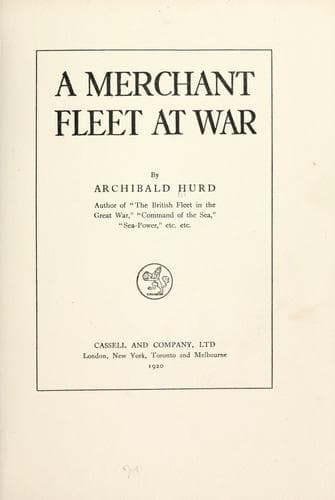
Cunard Steamship Company, ltd.; World War, 1914-1918 -- Naval operations
This included, as regarded submarines, the provision of 520 Oilers for
exhaust valve boxes, 40 tail-end shafts, 20 complete thrust blocks,
and the machining and complete fitting of four tail-end intermediate
shafts. At the same time 456 save-alls for oil fuel were designed and
provided--the pattern of these save-alls being afterwards adopted as
the standard pattern for the Navy. Nineteen thousand, eight hundred
manganese bronze spindles for mines were turned out, as well as 1,000
mine mechanism plates. When the Admiralty decided to fit naval and
merchant ships with the paravane contrivance, as a protection against
mines, the Cunard Company manufactured for them 5,728 sets of wires for
this gear. All this work was, of course, carried out in addition to the
ordinary routine of overhauling the Company’s own fleet.
This sort of work, however, valuable as it was, was perhaps only to
be expected of a large marine Company, so efficiently organised for
many years as the Cunard Company had been. But in addition, a large
amount of work was done for the armies in the Company’s workshops,
much of which required the highest degree of accuracy and extremely
skilled workmanship. One of the most important of such contracts was
the assembling of the 9·2 American Howitzer Equipment. These enormous
guns were shipped from the United States in parts, and the work of
completing, assembling, carrying out modifications in design, and
getting them ready for use in France, was done entirely in the Cunard
Works. Eighty-four of these equipments were dealt with, and, in
addition, 100 carriages and limbers and brake gear, which were a part
and parcel of the equipment, were manufactured. Owing to the fact that
the firing beams, which were received from the United States, were
found in practice to be insufficiently strong, the Company undertook
the stripping and re-inforcing of 73 sets of these.
[Illustration: ONE OF THE ROOMS IN THE CUNARD SHELL WORKS]
[Illustration: A RECORD OF “STRIKING” VALUE]
In the critical month of March, 1918, when the Allied armies were
retreating on the Western Front, and it was clear that the crucial
point of the war was imminent, the Ministry of Munitions sent out
urgent appeals to all Munition Works. During the great retreat,
although many of the actual guns were saved, there was no time to
attempt to bring away the gun beds, and in consequence many of the
larger calibre weapons were thus rendered useless. The Cunard Company
was then asked to undertake to supply one hundred sets in as short a
time as possible. Realising the urgency of the position, the Company
succeeded in engaging the assistance of several outside firms, who
carried out part of the work under Cunard supervision, with the amazing
result that no less than 146 sets were finished and delivered complete
within a fortnight.
Public-domain text, read in full here on John Shaqi.
Reviews
Reviews
No reviews yet
Be the first to share your thoughts on this work.
Join the Discussion
Join the discussion
Sign in to leave a comment or review.
Sign InorCreate an account