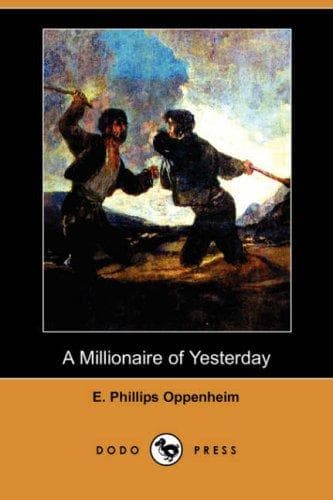
A Millionaire of YesterdayOppenheim, E. Phillips (Edward Phillips)
Philosophy
A Millionaire of Yesterday
Oppenheim, E. Phillips (Edward Phillips)
Detective and mystery stories; Fiction
She looked at him attentively. Her own heart was beating. If he had
not been engrossed by his care lest any one might over-hear their
conversation, he would have been astonished at the change in her face.
“You are talking in enigmas surely,” she said. “Nothing of that sort
could possibly happen to you. They tell me that the Bekwando Land shares
are priceless, and that you must make millions.”
“This afternoon,” he said, raising his glass to his lips and draining
it, “I think that I must have dozed upon the lawn at Ascot. I sat there
for some time, back amongst the trees, and I think that I must have
fallen to sleep. There was a whisper in my ears and I saw myself
stripped of everything. How was it? I forget now! A concession
repudiated, a bank failure, a big slump--what does it matter? The money
was gone, and I was simply myself again, Scarlett Trent, a labourer,
penniless and of no account.”
“It must have been an odd sensation,” she said thoughtfully.
“I will tell you what it made me realise,” he said. “I am drifting into
a dangerous position. I am linking myself to a little world to whom,
personally, I am as nothing and less than nothing. I am tolerated for my
belongings! If by any chance I were to lose these, what would become of
me?”
“You are a man,” she said, looking at him earnestly; “you have the nerve
and wits of a man, what you have done before you might do again.”
“In the meantime I should be ostracised.”
“By a good many people, no doubt.”
He held his peace for a time, and ate and drank what was set before him.
He was conscious that his was scarcely a dinner-table manner. He was
too eager, too deeply in earnest. People opposite were looking at them,
Ernestine talked to her vis-a-vis. It was some time before he spoke
again, when he did he took up the thread of their conversation where he
had left it.
“By the majority, of course,” he said. “I have wondered sometimes
whether there might be any one who would be different.”
“I should be sorry,” she said demurely.
“Sorry, yes; so would the tradespeople who had had my money and the men
who call themselves my friends and forget that they are my debtors.”
“You are cynical.”
“I cannot help it,” he answered. “It is my dream. To-day, you know, I
have stood face to face with evil things.”
“Do you know,” she said, “I should never have called you a dreamer, a
man likely to fancy things. I wonder if anything has really happened to
make you talk like this?”
He flashed a quick glance at her underneath his heavy brows. Nothing in
her face betrayed any more than the most ordinary interest in what
he was saying. Yet somehow, from that moment, he had uneasy doubts
concerning her, whether there might be by any chance some reason for
the tolerance and the interest with which she had regarded him from the
first. The mere suspicion of it was a shock to him. He relapsed once
more into a state of nervous silence. Ernestine yawned, and her hostess
threw more than one pitying glance towards her.
Public-domain text, read in full here on John Shaqi.
Reviews
Reviews
No reviews yet
Be the first to share your thoughts on this work.
Elsewhere in the archive
Join the Discussion
Join the discussion
Sign in to leave a comment or review.
Sign InorCreate an account