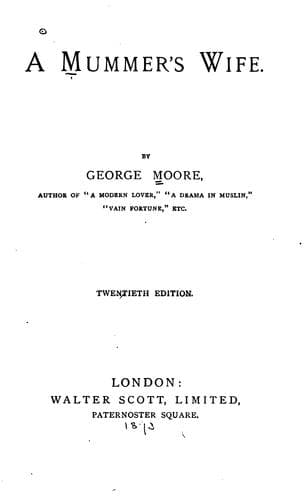
Actors -- Fiction; Adultery -- Fiction; Married people -- Fiction; Staffordshire (England) -- Fiction
The story proved a weary one; but like a long railway journey it at last
drew to an end, and they went upstairs. There they found the ladies yawning
and looking at the presents. Kate ran to Dick to ask him to arrange about
the music, but Beaumont had been a little before her and had taken Mr. Cox
out on the balcony. Bret was not in the room; Leslie did not know the
music, and in the face of so many difficulties, Dick's attention soon began
to wander, and Kate was left to console the disappointed musician. Once or
twice she attempted to renew the subject, but was told that they were all
going down to the theatre in half an hour, and that it had better be put
off to another time.
Montgomery made no answer, but he could not cast off the bitter and
malignant thought that haunted him, 'I'm as unfortunate in art as in love.'
XX
The ebb of the company's prosperity dated from Kate's marriage. Somehow
things did not seem to go well after. In the first place the production of
_Olivette_ was not a success. Mortimer was drunk, did not know his
words, and went 'fluffing all over the shop.' Kate, excited with champagne
and compliments, sang the wrong music on one occasion; and to complete
their misfortunes, the Liverpool public did not in the least tumble to Miss
Beaumont's rendering of the part of the heroine. The gallery thought she
was too fat, the papers said she was not sprightly enough, and on Wednesday
night the old _Cloches_ had to be put up. By this failure the
management sustained a heavy loss. They had laid out a lot of money on
dresses, property and scenery, all of which were now useless to them; and
the other two operas were beginning to droop and lose their drawing power,
having been on the road for the last three years. The country, too, was
suffering from a great commercial crisis, and no one cared to go to the
theatre. In many of the towns they visited strikes were on, and the people
were convulsed with discussions, projects for resistance, and hopes of
bettering their condition. Great social problems, the tyranny of capital,
and such-like, occupied the minds of men, and there was naturally little
taste for the laughing nonchalance of _La Fille de Madame Angot_ or
the fooling of the Baillie in the _Cloches_. As forty thousand men had
struck work, our band of travelling actors rolled out of Leeds, and they
left it bearing with them only a reminiscence of empty benches, and
street-corners crowded with idling, sullen-faced men. At Newcastle they
were not more fortunate, at Wigan they fared even worse, and at Hull it was
equally bad. Gaiety seemed to have fled out of the North; the public-house
and the platform drew away the pit and the gallery; the frequenters of the
boxes and dress-circle remained at home, to talk around their firesides of
their jeopardized fortunes. When the workers grow weary of work a hard time
sets in for the sellers of amusement, and the fate of Morton and Cox's
Operatic Company proved no exception to the rule.
Public-domain text, read in full here on John Shaqi.
Reviews
Reviews
No reviews yet
Be the first to share your thoughts on this work.
Elsewhere in the archive
Join the Discussion
Join the discussion
Sign in to leave a comment or review.
Sign InorCreate an account