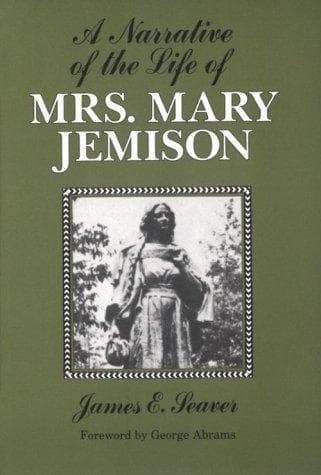
A Narrative of the Life of Mrs. Mary JemisonSeaver, James E. (James Everett)
History
A Narrative of the Life of Mrs. Mary Jemison
Seaver, James E. (James Everett)
Jemison, Mary, 1743-1833; Seneca Indians
After Allen came to Mt. Morris at that time, he married a girl by the
name of Morilla Gregory, whose father at the time lived on Genesee
Flats. The ceremony being over, he took her home to live in common with
his other wives; but his house was too small for his family; for Sally
and Lucy, conceiving that their lawful privileges would be abridged if
they received a partner, united their strength and whipped poor Morilla
so cruelly that he was obliged to keep her in a small Indian house a
short distance from his own, or lose her entirely. Morilla, before she
left Mt. Morris, had four children.
One of Morilla's sisters lived with Allen about a year after Morilla was
married, and then quit him.
A short time after they all got to living at Mt. Morris, Allen prevailed
upon the Chiefs to give to his Indian children, a tract of land four
miles square, where he then resided. The Chiefs gave them the land, but
he so artfully contrived the conveyance, that he could apply it to his
own use, and by alienating his right, destroy the claim of his children.
Having secured the land, in that way, to himself, he sent his two Indian
girls to Trenton, (N.J.) and his white son to Philadelphia, for the
purpose of giving each of them a respectable English education.
While his children were at school, he went to Philadelphia, and sold his
right to the land which he had begged of the Indians for his children to
Robert Morris. After that, he sent for his daughters to come home, which
they did.
Having disposed of the whole of his property on the Genesee river, he
took his two white wives and their children, together with his effects,
and removed to a Delaware town on the river De Trench, in Upper Canada.
When he left Mt. Morris, Sally, his squaw, insisted upon going with
him, and actually followed him, crying bitterly, and praying for his
protection some two or three miles, till he absolutely bade her leave
him, or he would punish her with severity.
At length, finding her case hopeless, she returned to the Indians.
At the great treaty at Big Tree, one of Allen's daughters claimed the
land which he had sold to Morris. The claim was examined and decided
against her in favor of Ogden, Trumbull, Rogers and others, who were the
creditors of Robert Morris. Allen yet believed that his daughter had an
indisputable right to the land in question, and got me to go with mother
Farly, a half Indian woman, to assist him by interceding with Morris for
it, and to urge the propriety of her claim. We went to Thomas Morris,
and having stated to him our business, he told us plainly that he had no
land to give away, and that as the title was good, he never would allow
Allen, nor his heirs, one foot, or words to that effect. We returned
to Allen the answer we had received, and he, conceiving all further
attempts to be useless, went home.
Public-domain text, read in full here on John Shaqi.
Reviews
Reviews
No reviews yet
Be the first to share your thoughts on this work.
Join the Discussion
Join the discussion
Sign in to leave a comment or review.
Sign InorCreate an account